
How to Care for Your Portulucaria afra (Elephant Bush)
Care Guide
Portulacaria
afra
The Elephant Bush — a fast-growing South African succulent shrub with small, round, bright green leaves on reddish woody stems, one of the most responsive and forgiving plants for pruning and shaping in any collection.
The Plant
Ancient form.
Forgiving nature.
Native to the Eastern Cape of South Africa, the Portulacaria afra grows as a sprawling succulent shrub in the thicket environments where it serves as a primary food source for elephants. In cultivation it is one of the most versatile and forgiving succulents available — fast-growing for a succulent, highly responsive to pruning, easy to propagate, and capable of developing a genuinely beautiful woody branch structure over years of appropriate care.
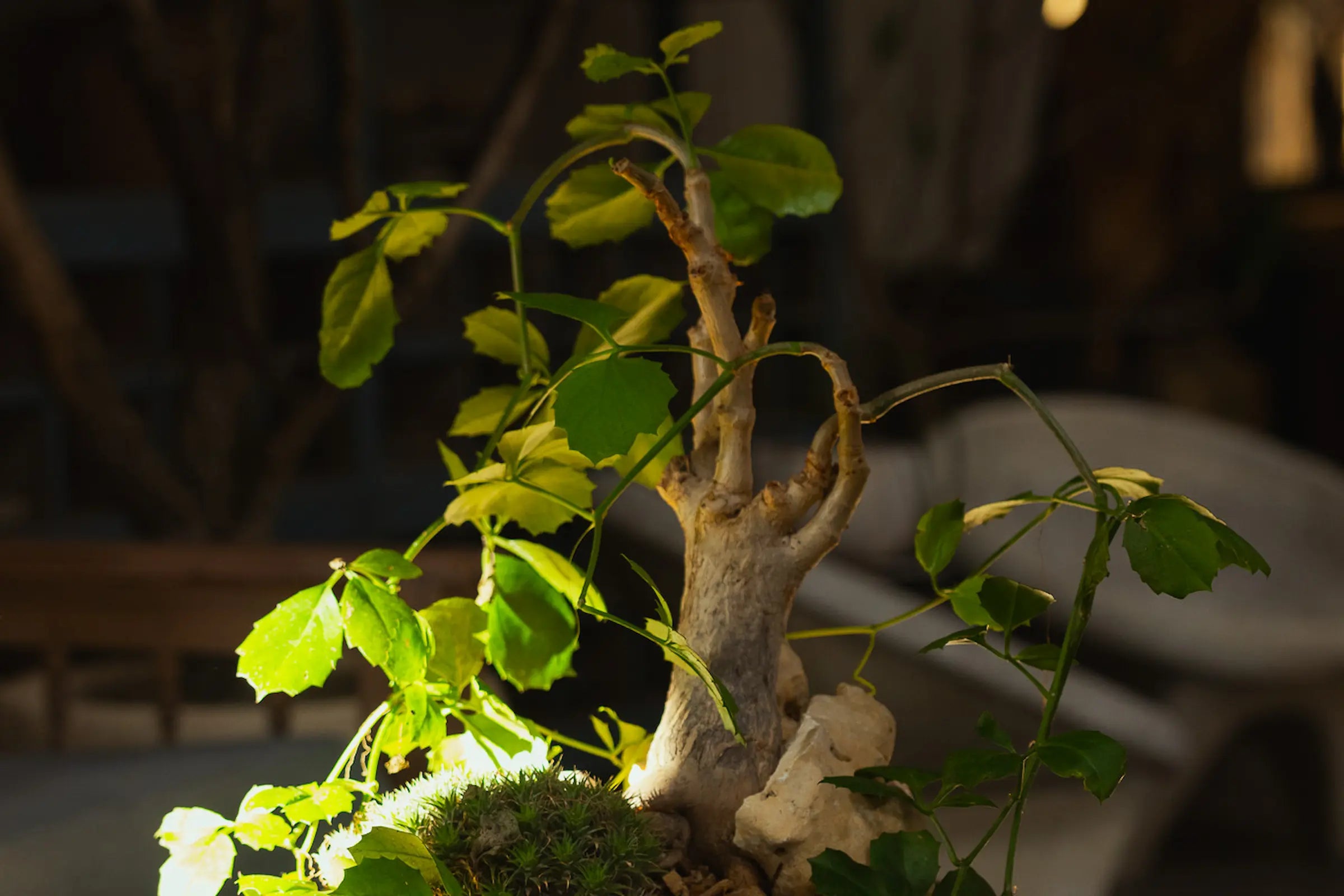
Often called "dwarf jade" for its resemblance to Crassula ovata, it grows considerably faster and is more flexible in stem structure — qualities that make it particularly valued for bonsai and shaped specimen work. The small, round, jade-green leaves on reddish-brown woody stems develop a progressively more characterful form that reads as ancient even in relatively young plants.
At a Glance
Light & Placement
The Elephant Bush performs best in bright, direct to bright indirect light. A south-facing window with several hours of direct sun daily is ideal and produces the most compact, dense growth and the richest, most vibrant coloration in the small, round leaves. It tolerates bright indirect light well and adapts to lower light better than many succulents — but in low light the branching becomes open and leggy, the leaves smaller, and the overall plant less structurally compelling.
For outdoor use in Southern California, full sun to partial shade both work — it is one of the most versatile succulents for outdoor conditions in this climate. See our Interior Plant Placement Guide for a framework on evaluating interior light levels.
Watering & Reading the Plant
Allow the soil to dry significantly between waterings — to at least the halfway point of the container before rehydrating. The Elephant Bush stores moisture in its small, succulent leaves and woody stems and handles extended dry periods readily. Water thoroughly and deeply when you do water, then allow a complete dry cycle. In the active season, every two to three weeks is typically appropriate. In winter, extend to three to four weeks. See our guide on how to know when to water your plants.
Well Hydrated
Leaves are plump, firm, and deeply colored. The soil is dry when probed but the plant is clearly well-hydrated. Continue the current interval.
Ready to Water
Leaves feel very slightly less plump than fully hydrated. The soil is dry to at least halfway down. Water slowly and thoroughly, then allow a complete dry cycle.
Overwatered
Stop watering immediately. Soft, yellowing leaves with consistently wet soil indicate overwatering. Allow extended drying and inspect the base of the stems for any soft tissue.
The Jade-Like Form
The Portulacaria afra is often called "dwarf jade" for its resemblance to the Crassula ovata — small, round, bright green leaves on succulent, reddish-brown woody stems. In fact it is a different genus entirely, and grows considerably faster than jade while being more flexible and less brittle in stem structure.
Over years it develops a characterful, woody branching structure with a progressively thickening stem base that reads as ancient and deliberate rather than casually grown. It is one of the most commonly used species in African traditional bonsai practice for exactly this quality: a plant that ages beautifully, developing a trunk and branch structure that looks venerable long before it actually is.
Temperature & Humidity
The Elephant Bush is native to eastern South Africa and adapted to a wide range of conditions — from hot, dry summer days to cool, dry winter nights. It tolerates temperatures from around 25 degrees Fahrenheit to over 100 degrees Fahrenheit, making it one of the most temperature-hardy succulents in this collection. In Southern California it can be grown outdoors year-round in most zones.
Humidity needs are minimal. Standard interior air is appropriate without supplemental intervention. In very humid conditions, ensure good airflow around the plant to prevent fungal issues on the dense branching structure.
Fertilizing
Feed lightly once a month during spring and summer with a balanced liquid fertilizer at half strength. The Portulacaria evolved in the well-drained, nutrient-lean soils of South Africa's Eastern Cape and Namaqualand regions and does not need or benefit from heavy feeding. Consistent, light feeding through the growing season supports steady growth without the soft, weak extension that over-fertilizing produces.
Stop feeding entirely in fall and winter. Resume in spring when new growth activity increases. For the complete approach to indoor fertilizing, see our guide on fertilizing indoor plants properly.
Pruning & Shaping
The Portulacaria afra is one of the most responsive and forgiving plants to prune in this entire collection. It can be shaped aggressively — removing up to one-third of the canopy in a single session — and responds with vigorous back-budding from areas of the stem where no leaves were previously visible. This makes it ideal for anyone interested in developing a more dramatically shaped specimen or practicing bonsai techniques.
Prune at any point during the growing season for best response, or in early spring before the main growing flush. Make clean cuts just above a leaf node. The sap is minimal and non-toxic. See our pruning guide for the full technical approach.
Repotting
Repot every two to three years in spring, or when the root system has clearly filled the container. Use a fast-draining cactus and succulent mix. The Elephant Bush develops a substantial root system that benefits from periodic fresh medium, but it can be kept deliberately root-bound to constrain its growth and concentrate trunk thickening — a technique used in traditional African bonsai work with this species.
Propagation: Extraordinarily easy from stem cuttings. Take a cutting of any size, allow to callous for 24 hours, and place in dry, fast-draining mix in bright light. Water very sparingly until roots develop — typically within two to four weeks. This is one of the most reliable succulent propagations available.
Common Issues
The Portulacaria afra is one of the most robust and forgiving plants in this collection. Problems are rare and almost always trace to overwatering.
Leaf Drop
Overwatering is the most common cause of unexpected leaf drop. Allow the soil to dry more between waterings. Some leaf drop from the innermost, shaded branches is normal as the plant grows and the interior becomes more shaded.
Soft or Mushy Stems
Stem rot from overwatering. Stop watering immediately. Allow complete drying. If the main stem base is affected, the plant may be recoverable by taking cuttings from healthy stems above the rot line and propagating fresh plants.
Leggy or Open Growth
Insufficient light. Move to a brighter position and prune back the leggy growth to encourage denser branching in the improved conditions.
Pale or Washed-Out Leaf Color
Insufficient light for the plant to maintain rich leaf color. Portulacaria that receive more direct sun produce deeper, more vibrant green leaves. Move to a brighter position.
Fine webbing and stippling on the small leaves in dry conditions. Treat with neem oil or insecticidal soap applied to all surfaces. Repeat weekly for three to four weeks.
White cottony deposits at leaf axils and stem junctions. Treat with isopropyl alcohol on a cotton swab then follow with neem oil. Repeat weekly until clear.
Inspect neighboring plants immediately. Scrape away manually and treat all surfaces with neem oil. Repeat weekly for a full month.
Dust on Leaves
The small round leaves collect dust efficiently. Mist gently or wipe with a soft damp cloth. Do not use leaf shine products.
Growth & Lifespan
The Portulacaria afra is a fast grower for a succulent — noticeably extending its branching through the active season — and becomes progressively more characterful with age as the stem base thickens and the bark develops texture. It is genuinely forgiving of imperfect care, bouncing back readily from neglect, overwatering, and even significant pruning.
In the wild it is an important part of the Eastern Cape thicket ecosystem, serving as a major food source for elephants (which gives it its common name) and as a significant carbon sequestration plant. In cultivation, given appropriate light and a measured hand with water, it becomes a reliable, long-lived, and progressively more beautiful addition to any collection — the succulent equivalent of a plant that always has more to give.
The Plant Daddies Society
Let us handle
the care.
Weekly expert visits, full plant protection, and a living collection that grows with you. The Society takes the guesswork out of plant ownership entirely.
%0A%0A%0A%0A%0A%0A%20%20%0A%0A%20%20Care%20Guide%0A%20%20Portulacariaafra%0A%0A%20%20The%20Elephant%20Bush%20%E2%80%94%20a%20fast-growing%20South%20African%20succulent%20shrub%20with%20small,%20round,%20bright%20gre...)