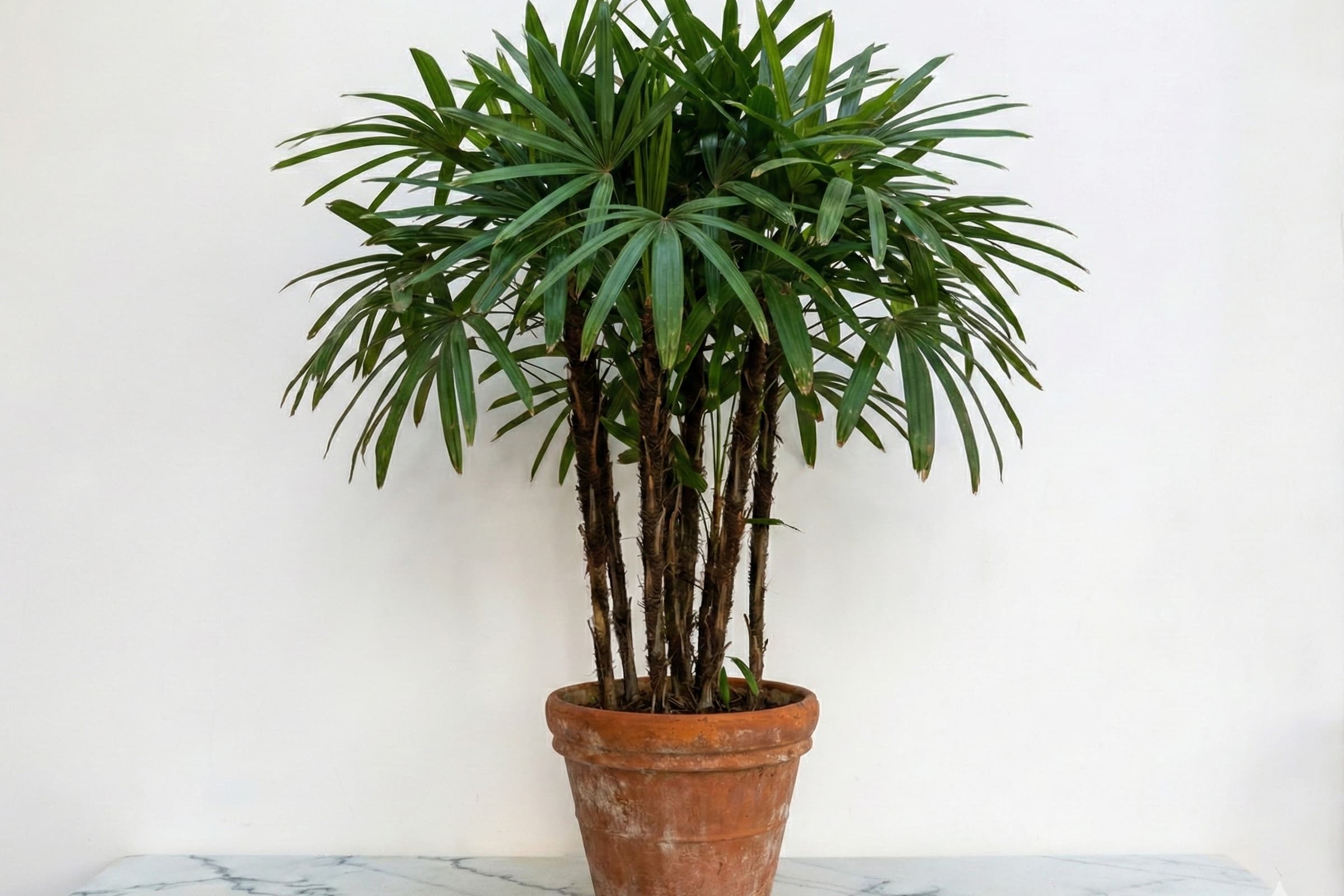
How to Care for Your Tupidanthus calyptratus (Mallet Flower)
Care Guide
Tupidanthus
Calyptratus
The Mallet Flower. A bold tropical species with large palmate leaves, strong upright presence, and one of the most striking variegated forms in interior horticulture.
The Plant
Palmate canopy.
Bold presence.
Native to the tropical forests of South and Southeast Asia — spanning India, Nepal, and southern China — the Tupidanthus calyptratus is a member of the Araliaceae family and a relative of the Schefflera. Its leaves emerge in dramatic palmate clusters, each leaflet radiating outward like a hand from the stem, creating a canopy that is both bold and layered.
Indoors it grows into a clean, structured tree with a strong central trunk and an architectural silhouette. It is tolerant, adaptable, and far less temperamental than many large-leafed tropical species — rewarding consistent light and measured watering with steady, confident growth year over year.
At a Glance
Tupidanthus calyptratus
Green
The standard form produces deep, glossy green palmate leaves that develop a rich, uniform color in good light. It is the more vigorous of the two varieties — growing faster, tolerating a slightly wider range of light conditions, and recovering more quickly from stress or environmental changes. Its bold, unbroken foliage gives it a clean, modern quality that suits contemporary interiors beautifully. If you want volume and presence with minimal management, this is the one.
More forgiving of lower light — still needs bright indirect for best leaf size and density.
Tupidanthus calyptratus
Variegated
The variegated form carries irregular cream, white, and pale yellow markings across its palmate leaves — no two leaves patterned alike. It is slower growing than the standard form and requires more careful management, particularly around light. The pale sections of each leaf contain little to no chlorophyll, meaning the plant has less photosynthetic capacity overall and depends more heavily on what the green portions can do. In the right conditions, it is one of the most visually striking indoor trees available. In the wrong conditions, it sulks visibly and quickly.
Needs brighter, more consistent light than the standard form. Reverts to all-green in low light over time — the variegation stabilizes and intensifies with stronger illumination.
Light
The Tupidanthus performs best in bright, indirect light — a well-lit room where strong illumination fills the space throughout the day. A position near a large east- or south-facing window is ideal. Consistent, steady light is what drives leaf size: plants in stronger conditions produce larger, more dramatically structured palmate foliage, while low light leads to smaller leaves, longer internodes, and a more open, leggy silhouette over time.
Choose a location and commit to it. Frequent relocation causes the plant to pause growth and can trigger older leaves to yellow and drop as it adjusts. Once settled in the right spot, leave it.
Variegated variety — light is non-negotiable: The variegated form needs consistently brighter conditions than the standard. In lower light, the plant will not only slow down — the variegation itself will begin to reduce as the plant produces more chlorophyll-rich green growth to compensate. Brighter light preserves and intensifies the patterning. If your variegated specimen is producing increasingly green new leaves, move it somewhere brighter.
Watering
The Tupidanthus sits in the middle zone — it doesn't want to dry out completely, but it doesn't like sitting in consistently wet soil either. Allow the top 30–40% of the container to dry before watering again, then water slowly and evenly until the entire root zone is hydrated. Check with your finger or a moisture probe below the surface rather than judging by the top layer alone.
Rhythm shifts with the season. In spring and summer the plant draws more actively and may need watering every seven to ten days. In fall and winter, growth slows and soil holds moisture longer — extend the interval rather than maintaining a fixed schedule. The plant will signal its needs before any visible decline: leaves that soften slightly or begin to droop gently are telling you it's ready.
Warning signs: Yellowing leaves — particularly from the lower canopy upward — almost always indicate too much water too frequently. Leaves that are uniformly limp and the soil is fully dry point to the opposite. Read the soil, not just the foliage.
Humidity & Temperature
The Tupidanthus is more tolerant of standard interior conditions than many tropical statement plants. It performs well in moderate ambient humidity — the levels typical of most well-maintained homes — and doesn't require supplemental humidification in most environments. In particularly dry heated or air-conditioned spaces, a humidifier or grouping with other plants will improve leaf quality and reduce tip browning.
Keep temperatures between 60–85°F. This species has no cold tolerance and should be kept away from drafty windows, exterior walls, and cold air vents. A single sustained cold exposure can cause significant leaf drop and slow recovery. Stable warmth and consistent light are the two most important environmental factors for long-term health.
Fertilizing
Feed monthly through spring and summer with a balanced liquid fertilizer. The Tupidanthus responds well to consistent, moderate feeding during the active growing season — larger new leaves, faster extension, and deeper color in the standard form.
For the variegated form, stick to the same schedule but don't be tempted to increase the dose. Heavier feeding produces faster green growth that can actually push the variegation toward reversion — moderate and steady is better. Pause all fertilizing in fall and winter as growth slows and the plant rests.
Pruning
Pruning the Tupidanthus is primarily maintenance rather than shaping. Remove aging lower leaves as they yellow and decline — they won't recover and holding onto them draws energy away from new growth. For height control or to encourage a more branched canopy, cut just above a node in early spring. The plant will push new growth from below the cut, gradually filling out the silhouette.
For the variegated form, remove any fully reverted all-green shoots promptly. Green shoots grow more vigorously than the variegated tissue — if left unchecked, they can take over the plant entirely, pushing out the patterned growth you're trying to maintain.
Repotting
Repot every one to two years, or sooner when roots begin to fill the vessel and growth has noticeably slowed despite consistent care. Spring is the right window — the plant is entering its active phase and will settle quickly into fresh medium.
Use a well-structured indoor mix with good aeration — one that holds moisture evenly without compacting. Move up one container size at a time. An oversized pot holds water the roots can't yet use, which recreates overwatering conditions regardless of how carefully you water. After repotting, hold off on fertilizing for four to six weeks to let the roots establish in the new medium.
Common Issues
Yellowing Leaves
Most often linked to overwatering or soil staying wet for extended periods. Allow the mix to dry further between waterings. Occasional lower yellowing as the plant pushes new growth is normal and not a concern.
Drooping Foliage
If the soil is dry, the plant is thirsty — water thoroughly. If the soil is wet and leaves are drooping, that's overwatering stress. Allow a full dry-out before watering again.
Smaller New Leaves
Typically insufficient light or a root system that has outgrown its container. Move to a brighter spot first, then assess whether repotting is due.
Leaf Drop After Relocation
Stress-related and temporary. Give the plant two to four weeks to acclimate to its new position before making any further changes. Avoid moving it again during the adjustment period.
Variegation Fading (variegated only)
New leaves emerging more green than patterned is a clear signal of insufficient light. Move to a brighter position. Remove any fully green reverted shoots promptly to prevent them from outcompeting the variegated growth.
Spider Mites, Scale, Mealybugs
Inspect regularly, particularly at leaf joints and the undersides of palmate leaflets where pests congregate. Treat at first sight with neem oil or insecticidal soap weekly for three to four weeks. Maintain good airflow and keep foliage clean.
Growth & Lifespan
The Tupidanthus calyptratus grows steadily indoors, forming a strong central trunk and broad palmate canopy that becomes more architectural and refined with each passing year. The standard form is one of the more vigorous large-leafed indoor trees — in bright conditions you can expect consistent seasonal extension and regular new leaf production. The variegated form grows at a more measured pace but offers something rarer in return: a changing, living pattern that no two specimens express in quite the same way.
Given the right conditions, either form becomes a long-lived centerpiece. These are not rotating seasonal plants — they are permanent fixtures that deepen in character and presence over years of undisturbed, consistent care.
The Plant Daddies Society
Let us handle
the care.
Weekly expert visits, full plant protection, and a living collection that grows with you. The Society takes the guesswork out of plant ownership entirely.