
How to Care for Your Monstera deliciosa (Swiss Cheese Plant)
Care Guide
Monstera
deliciosa
The Swiss Cheese Plant — a tropical climbing aroid from the rainforests of Mexico and Central America, with enormous, deeply fenestrated leaves of extraordinary botanical architecture and one of the most distinctive canopies of any interior plant.
The Plant
The fenestrated leaf.
Rainforest architecture.
Native to the tropical rainforests of Mexico and Central America, the Monstera deliciosa has become one of the most widely recognized and desired interior plants in the world — and for reasons that extend well beyond trend. Its leaves are genuinely extraordinary: enormous, deeply cut, and fenestrated with holes and splits that are purposeful evolutionary adaptations rather than damage or defect. As the plant matures, each successive leaf becomes larger and more elaborately fenestrated than the one before.
It is a plant that grows visibly and dramatically through the warm months — producing multiple new leaves per season in good conditions, climbing its support steadily, developing aerial roots that reach toward the soil, and becoming more botanically complex and more visually compelling with each passing year.
At a Glance
Light & Placement
The Swiss Cheese Plant thrives in bright, indirect light — the kind of diffuse, consistent brightness found two to three meters from a south-facing window, or directly beside an east-facing window. In its native Mexican and Central American rainforest understory it grows as a climbing plant under the forest canopy, adapted to high-quality indirect light rather than full sun. In good indirect light it produces its characteristic fenestrated (windowed) leaves at their full mature size. In lower light the leaves emerge smaller and with fewer or no fenestrations.
Direct sun bleaches and scorches the large leaves rapidly. The goal is maximum indirect brightness — the kind of position where a book would be easy to read throughout the day. For a practical framework on evaluating your interior light levels, see our Interior Plant Placement Guide.
Fenestration requires good light. The characteristic holes and splits in mature Monstera leaves — the feature most people find most compelling — only develop in adequate bright indirect light. In lower light, leaves emerge whole and smaller. If your Monstera's leaves are consistently solid without holes, move it to a brighter position.
Watering & Reading the Plant
Allow the top two inches of soil to dry between waterings. The Monstera prefers moderate, consistent moisture — it is not as drought-tolerant as the succulents and caudiciform plants in this collection, but it should not be kept consistently wet. Water thoroughly when you water, allowing it to flow from the drainage holes, then allow the partial dry cycle to complete before returning. Every seven to ten days in the active season; ten to fourteen days in winter. See our guide on how to know when to water your plants.
Well Hydrated
Leaves are held with full tension and the soil is still moist in the top two inches. No water needed — continue the current interval.
Ready to Water
The top two inches of soil are dry when probed. Leaves may show very slight reduction in their usual full tension. Water slowly and thoroughly.
Overwatered
Stop watering immediately. Yellowing leaves or soft stem tissue with consistently wet soil indicate overwatering. Allow extended drying and assess drainage before resuming.
Fenestration & Leaf Development
The distinctive holes and splits in mature Monstera deliciosa leaves — the fenestrations that give the plant its common name "Swiss Cheese Plant" — are one of the most fascinating examples of purposeful leaf modification in the plant world. They are not defects or damage: they are a highly developed adaptation that allows large leaves to allow light and wind to pass through, reducing the chance of the leaf acting as a sail that could tear the plant from its support in storm conditions.
Fenestrations appear progressively as the plant matures — young plants produce solid, unbroken leaves; adolescent plants produce leaves with splits along the margins; mature plants produce the fully windowed, deeply cut leaves that represent the species at its most visually compelling. This developmental progression is entirely normal and cannot be rushed by any means other than providing ideal growing conditions and waiting for the plant to mature.
New leaves unfurl dramatically. Each new Monstera leaf emerges as a tightly rolled, pale green cylinder and unfurls slowly over several days into its full form. This process is one of the most visually compelling events in any plant collection — avoid disturbing the plant during the unfurling process.
Temperature & Humidity
The Monstera deliciosa prefers consistent warmth — 65 to 85 degrees Fahrenheit — and moderate to high humidity. It is a tropical plant sensitive to temperatures below 55 degrees Fahrenheit and to cold drafts. In Southern California it can be grown outdoors in sheltered, shaded positions through most of the year.
Moderate to high humidity — 50 to 70 percent — is preferred. In dry interior conditions during winter heating season, leaf edges may brown and new leaves emerge with less prominent fenestration. A room humidifier positioned nearby, regular misting of the leaves, or grouping with other tropical plants helps maintain adequate moisture in the air around the plant.
Fertilizing
Feed monthly during spring and summer with a balanced liquid fertilizer at half strength. The Monstera is an active feeder in the growing season and benefits from consistent nutrition to support its large leaf production and active growth. Stop fertilizing in fall and winter. Resume in spring when new growth becomes active. See our guide on fertilizing indoor plants properly.
Support & Training
The Monstera deliciosa is a climbing plant that, given a support to ascend, produces progressively larger and more dramatically fenestrated leaves as it climbs — registering that it is moving upward and redirecting energy toward larger, more elaborate leaf production. A moss pole, wooden stake, or trellis provides the ideal support. As aerial roots emerge from the nodes, guide them toward the pole and they will attach naturally.
See our pruning guide for guidance on managing both the climbing structure and the leaf production of this species over time.
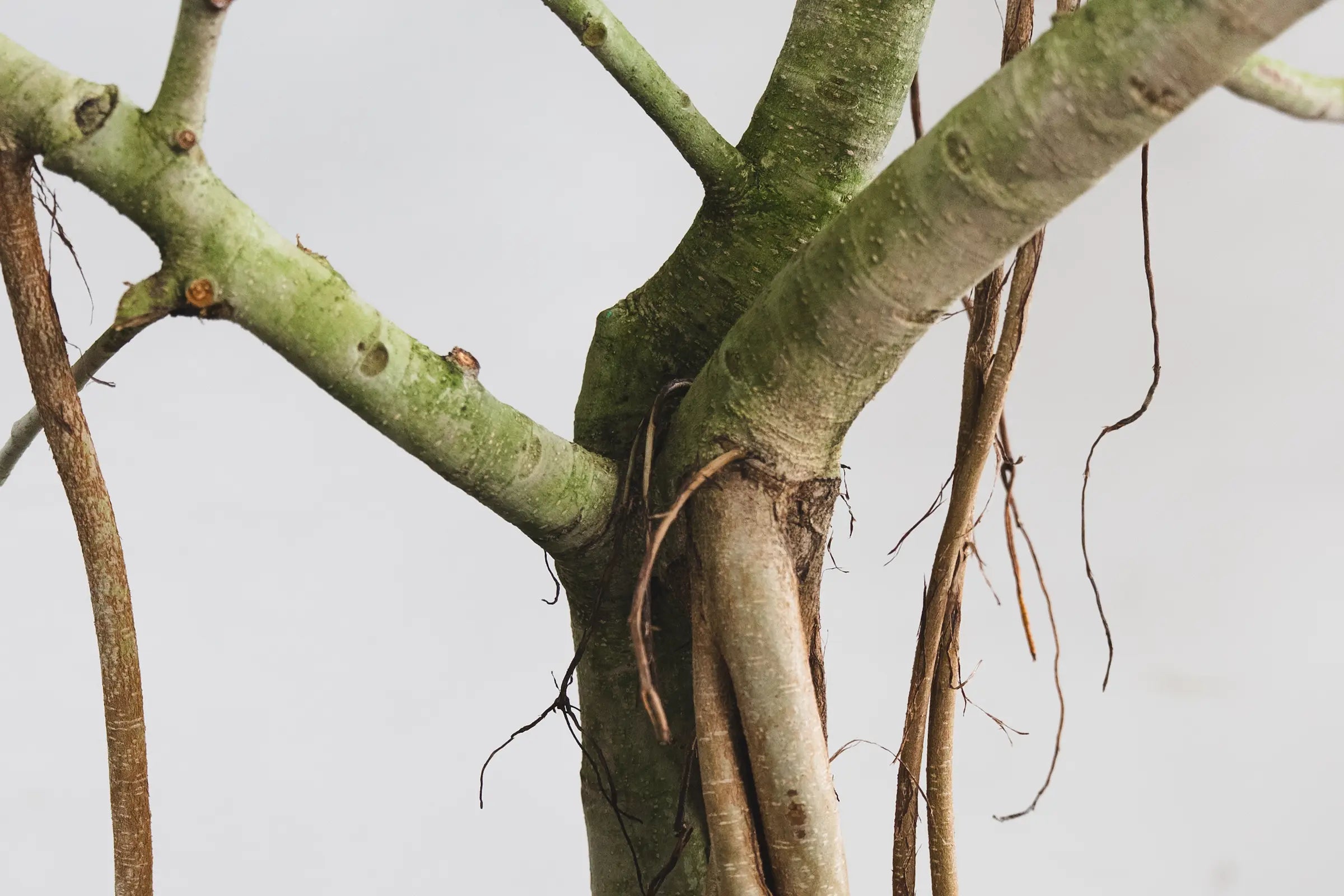
Aerial roots are normal. Long, pale aerial roots emerging from the nodes and stems are completely normal and healthy — they are the same roots that in the wild anchor the plant to tree trunks as it climbs. Direct them toward the soil or moss pole rather than removing them.
Repotting
Repot every two years in spring, or when roots are clearly filling the container. The Monstera is a vigorous root-grower in good conditions. Use a quality well-draining indoor potting mix and size up by one to two containers depending on how root-bound the plant has become.
Propagation: From stem cuttings with at least one node and one aerial root taken in spring or early summer. Allow the cut surface to callous briefly, then place in moist potting mix or water. Roots develop in two to four weeks in warm, humid conditions.
Common Issues
The Monstera deliciosa is robust and generally low-maintenance. Most issues trace to overwatering causing root stress, insufficient light reducing leaf size and fenestration, or dry air causing tip browning.
No Fenestrations
The leaves are emerging whole without holes — insufficient light. Move to a brighter indirect position. Fenestrations will appear on new leaves once light is adequate.
Yellow Leaves
Overwatering while soil remains consistently wet is the most common cause. Allow the soil to dry more between waterings and confirm drainage is correct.
Brown Leaf Edges and Tips
Low humidity or salt accumulation. Increase ambient humidity with a humidifier and flush the soil with plain water to clear any salt buildup.
Leggy Growth Between Leaves
Insufficient light — the plant extending toward its light source. Move to a brighter position.
Fine webbing and stippling on leaf surfaces in dry stagnant conditions. The large leaf surfaces are the primary habitat — treat both surfaces thoroughly with neem oil or insecticidal soap. Repeat weekly for three to four weeks.
White cottony deposits at leaf axils and the base of the large leaves. Treat with isopropyl alcohol on a cotton swab then follow with neem oil. Repeat weekly.
Inspect neighboring plants immediately. Scrape away and treat with neem oil. Repeat weekly for a full month.
Dust on Leaves
The broad leaf surfaces collect dust and reduce photosynthetic efficiency over time. Wipe gently with a soft damp cloth, top and underside. Do not use leaf shine products. Regular cleaning also lets you detect early pest activity before it spreads.
Growth & Lifespan
The Monstera deliciosa is one of the most rewarding long-term tropical plants for interior use — growing actively through the warm months, producing multiple new leaves per season in good light, and developing progressively more dramatic and more fully fenestrated leaves as the plant matures and climbs.
Given bright indirect light, a climbing support to ascend, adequate humidity, and monthly feeding through the growing season, it becomes one of the most botanically spectacular interior plants available — a plant whose individual leaves are compelling works of botanical architecture in themselves, and whose continued development keeps it engaging season after season.
The Plant Daddies Society
Let us handle
the care.
Weekly expert visits, full plant protection, and a living collection that grows with you. The Society takes the guesswork out of plant ownership entirely.
%0A%0A%0A%0A%0A%0A%20%20%0A%0A%20%20Care%20Guide%0A%20%20Monsteradeliciosa%0A%0A%20%20The%20Swiss%20Cheese%20Plant%20%E2%80%94%20a%20tropical%20climbing%20aroid%20from%20the%20rainforests%20of%20Mexico%20and%20C...)