How to Care for your Pachira aquatica (Money Tree)
Care Guide
Pachira
aquatica
The Money Tree — a tropical wetland tree from Central and South America with large, palmate compound leaves of rich deep green, an often-braided decorative trunk, and one of the most reliably beautiful tropical presences available for bright interior spaces.
The Plant
Palmate canopy.
Wetland origins.
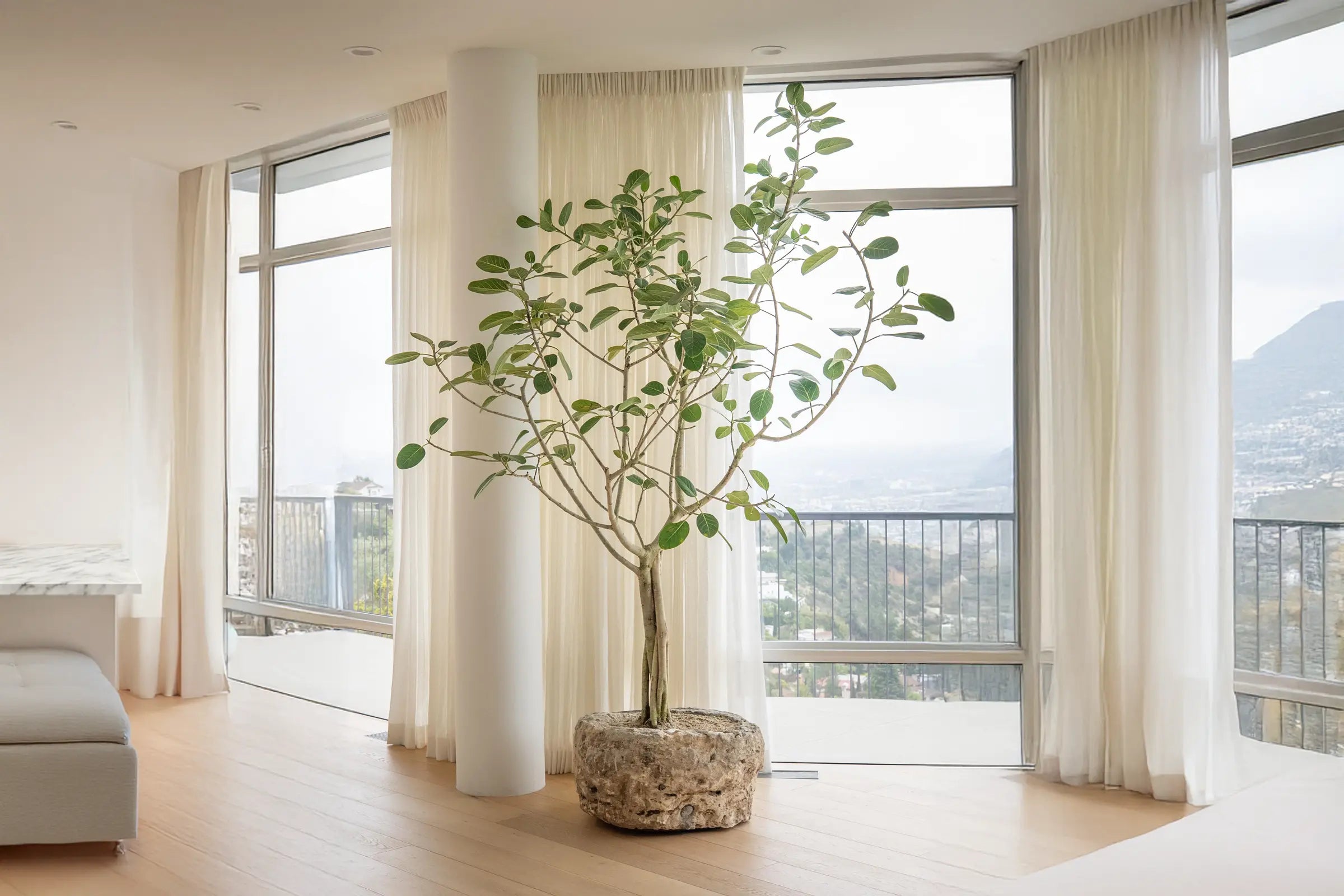
Native to the tropical wetlands, riverbanks, and flooded forests of Central and South America, the Pachira aquatica is cultivated worldwide as an interior plant prized for its large, palmate compound leaves — five to seven oval, deep green leaflets radiating from a central point — and its frequently braided, decorative trunk presentation. It is one of the most reliably beautiful and genuinely non-toxic large tropical indoor trees available.
Its wetland origin gives it a preference for consistent moisture rather than extended drought — a care profile quite different from the succulents and caudiciform plants in this collection and more aligned with the forest tropical species. In good bright indirect light it grows vigorously and develops into an increasingly lush and canopied specimen.
At a Glance
Light & Placement
The Money Tree thrives in bright, indirect light — a position near a south or east-facing window with strong, consistent indirect exposure throughout the day. In its native tropical wetland and riverbank habitat it grows in dappled light under a taller forest canopy and brings a preference for bright indirect rather than full sun into cultivation. In genuinely bright conditions it produces large, deep green compound leaves with excellent texture and maintains its compact, upright branching structure.
In lower light the leaves become smaller, the internodal spacing increases, and the braided trunk — if present — becomes less of the focal point as the overall plant becomes less vigorous. Bright indirect light is the target. For a practical framework on evaluating your interior light levels, see our Interior Plant Placement Guide.
Watering & Reading the Plant
Allow the top one to two inches of soil to dry between waterings. The Money Tree tolerates its native wetland origin — occasional flooding followed by dry periods — and prefers a similar moderate but not consistently wet cycle in cultivation. Water thoroughly when you water, then allow the partial dry cycle to complete. Every seven to ten days in the active season; ten to fourteen days in winter. See our guide on how to know when to water your plants.
Well Hydrated
The palmate compound leaves are held with full tension. Soil is still moist in the top inch or two. No water needed — continue the interval.
Ready to Water
The top one to two inches of soil are dry. Leaves may show very slight reduction in tension. Water slowly and thoroughly.
Overwatered
Stop watering immediately. Yellowing leaves or stem softening with consistently wet soil indicate overwatering. Allow extended drying before resuming.
The Braided Trunk & Palmate Leaves
The Pachira aquatica is sold commercially in two distinct presentations: the natural, single-stemmed form that grows as a proper tree; and the braided form, in which multiple young stems are woven together during growth and allowed to fuse at the bases over time, creating a decorative, sculptural trunk structure. Both are healthy expressions of the same species — the braided form is a horticultural style choice rather than a botanical modification.
The palmate compound leaves — five to seven large, oval leaflets arranged radially from a central point on the petiole — are the plant's most consistently beautiful feature regardless of trunk presentation. Each leaflet is a rich, deep green with a smooth, slightly glossy surface and a prominent pale midrib. The leaves are large enough to catch and hold light in a way that makes the canopy genuinely luminous in a bright interior position.
Temperature & Humidity
The Money Tree prefers consistent warmth — 65 to 85 degrees Fahrenheit — and moderate to high humidity. It is a tropical wetland plant sensitive to temperatures below 55 degrees Fahrenheit and to cold drafts. Keep away from exterior doors, air conditioning vents, and uninsulated windows in winter.
Moderate to high humidity — 50 to 65 percent — is preferred. In very dry interior conditions during winter heating season, the leaflet tips may brown — a humidity issue rather than a watering one. A room humidifier nearby or grouping with other tropical plants helps maintain adequate ambient moisture.
Fertilizing
Feed monthly during spring and summer with a balanced liquid fertilizer at half strength. The Money Tree is an active feeder in the growing season and benefits from consistent nutrition. Stop fertilizing in fall and winter. Resume in spring when new growth becomes active. For the complete approach, see our guide on fertilizing indoor plants properly.
Pruning & Shaping
The Money Tree responds well to pruning. Prune in spring before the main growing flush. Each pruned tip produces multiple branches below the cut, building canopy density. Remove any leggy or sparse stems at their origin. If the plant becomes too tall, the main stem can be cut at any point and new branches will emerge from just below the cut.
See our pruning guide for the complete technique.
Repotting
Repot every two years in spring, or when roots are clearly filling the container. Use a quality well-draining indoor potting mix. Size up by one container. If the plant is braided, take care not to damage the fused trunk structure during repotting.
Propagation: From stem cuttings taken in spring or summer with two to three nodes. Roots develop in four to six weeks in moist mix in warm, humid conditions.
Common Issues
Yellow Leaves
Overwatering while soil remains consistently wet is the most common cause. Allow extended drying and confirm drainage is correct.
Brown Leaf Tips
Low humidity or salt accumulation from over-fertilizing. Increase ambient humidity and flush the soil with plain water to clear salts.
Leaf Drop
Cold draft or significant temperature change. Identify and address the source. Some natural aging of the oldest lower leaves is also normal.
Stem Yellowing in Braided Trunk
If one or more of the braided stems yellows significantly, it may be dying — sometimes one stem in a multi-stem braid does not survive long-term. Remove the dead stem cleanly and allow the remaining stems to continue. The surviving stems will develop normally.
Fine webbing and stippling on leaf surfaces in dry conditions. Treat with neem oil or insecticidal soap applied to all surfaces. Repeat weekly for three to four weeks.
White cottony deposits at leaf axils and where leaflets meet the central petiole. Treat with isopropyl alcohol on a cotton swab then follow with neem oil. Repeat weekly.
Inspect neighboring plants immediately. Scrape away and treat with neem oil. Repeat weekly for a full month.
Dust on Leaves
The broad leaf surfaces collect dust and reduce photosynthetic efficiency over time. Wipe gently with a soft damp cloth, top and underside. Do not use leaf shine products. Regular cleaning also lets you detect early pest activity before it spreads.
Growth & Lifespan
The Pachira aquatica is a rewarding long-term interior tree that grows actively in good conditions, producing multiple new compound leaves through the warm months and developing increasingly lush canopy density over years.
Given bright indirect light, consistent moderate moisture, adequate humidity, and monthly feeding through the growing season, it becomes one of the most reliably beautiful tropical interior trees available — with a leaf quality and canopy density that holds its visual appeal across all seasons.
The Plant Daddies Society
Let us handle
the care.
Weekly expert visits, full plant protection, and a living collection that grows with you. The Society takes the guesswork out of plant ownership entirely.