How to Care for Your Bursera fagaroides (Copalwood Tree)
Care Guide
Bursera
Fagaroides
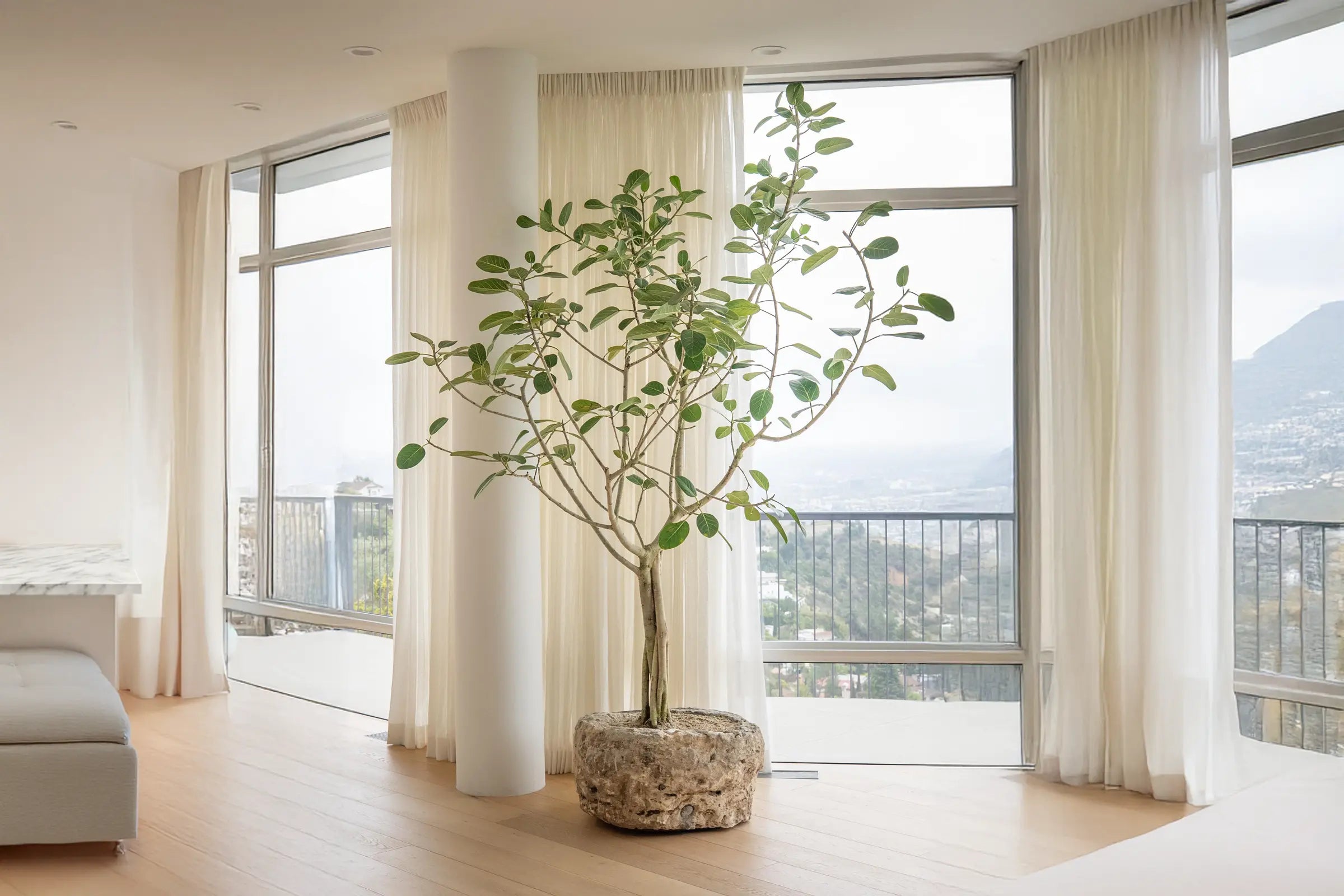
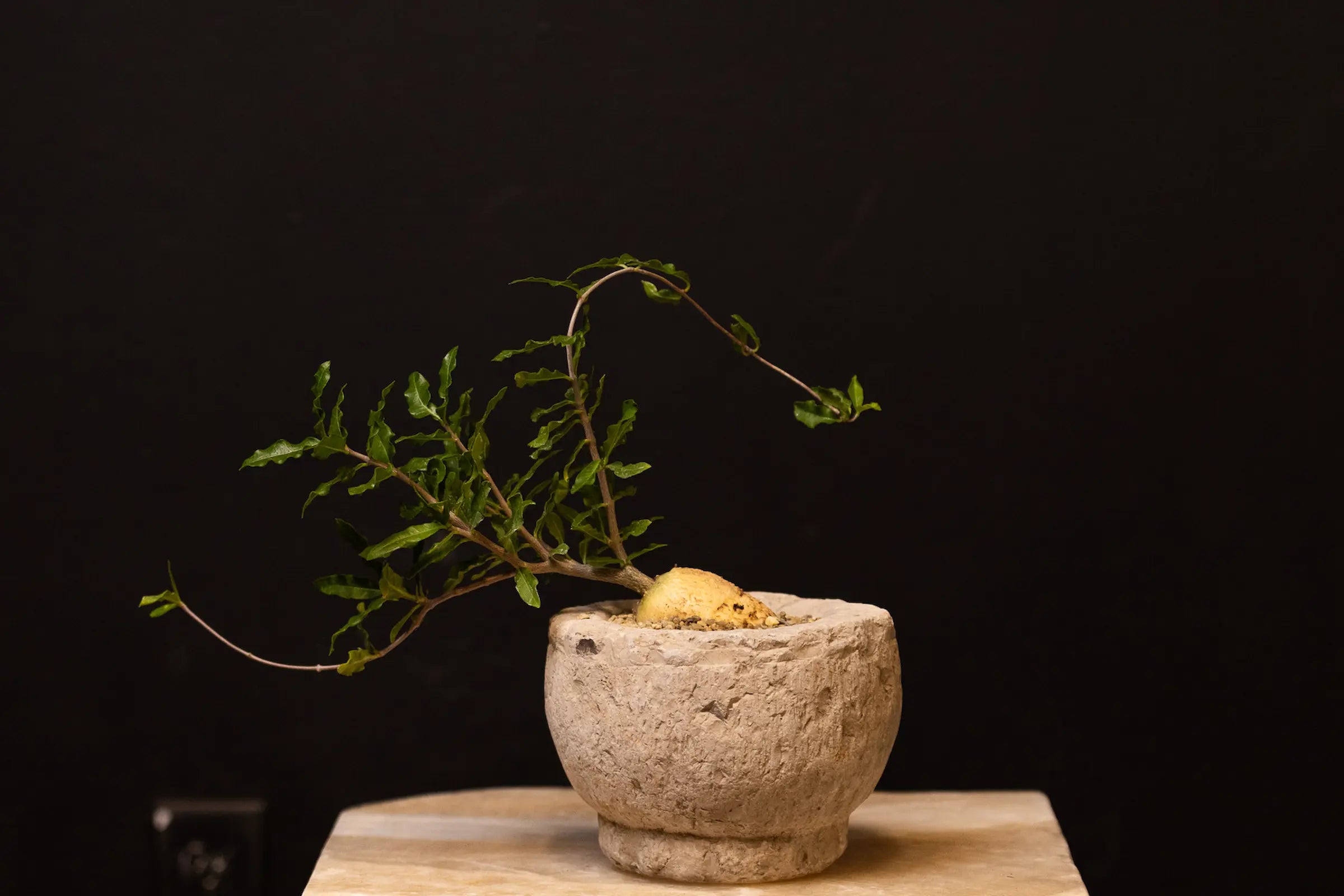
The Copalwood Tree. Papery, exfoliating bark revealing layers of green and copper beneath — a member of the frankincense family with aromatic resin, delicate feathery foliage, and one of the most compelling trunk characters available in indoor cultivation.
The Plant
Frankincense family.
Mexican desert.
Native to the tropical dry forests of Mexico and Central America — the same arid, thorny landscapes that shaped the Operculicarya in Madagascar — the Bursera fagaroides belongs to the Burseraceae family: the frankincense and myrrh family. Its trunk produces aromatic resins that have been used in indigenous copal ceremonies for centuries, and the tree carries a quietly ancient quality that is difficult to quantify but immediately felt when you're in its presence.
What makes it visually extraordinary is the bark. As the trunk develops, it exfoliates in translucent papery sheets — peeling away to reveal layers of green, yellow, and copper-toned fresh bark beneath. The effect is constantly changing, seasonal, and genuinely unlike any other tree you can keep indoors. Above it, delicate pinnate leaves — fine and feathery, almost fern-like in their lightness — contrast with the heavy, textured trunk in a way that gives the plant its characteristic combination of bold base and airy canopy.
At a Glance
Light
The Bursera fagaroides comes from some of the brightest, most sun-exposed environments in Mexico — rocky dry forest slopes under intense direct sun. Indoors it needs the brightest position available: a south-facing windowsill with direct sun for several hours daily is ideal. Strong, consistent light drives trunk thickening, supports the tight, compact branching structure that makes the miniature tree form so refined, and is the primary variable that determines how much character this plant develops each season.
In lower light, growth slows dramatically, branches become more open and etiolated, and the trunk develops more slowly. The contrast between bold trunk and delicate foliage — the plant's defining tension — is only fully realized when it's growing in conditions that keep both elements performing at their best. A south window is worth fighting for with this one.
Supplemental lighting: If a truly bright south-facing position isn't available, a full-spectrum grow light positioned close to the canopy significantly improves conditions. The Bursera responds well to supplemental light and will reward the investment with noticeably denser branching and faster trunk development.
Watering
The Copalwood Tree stores moisture in its trunk and root system — it is adapted to the prolonged dry seasons of Mexican tropical dry forest and benefits from extended dry periods between waterings. Allow the soil to dry almost completely before watering again. Check several inches below the surface rather than judging by the top layer alone, then water slowly and thoroughly so the entire root zone hydrates before the next long dry cycle begins.
During the active growing season in spring and summer, watering every two to three weeks is typical. In winter dormancy, when the leaves have dropped, reduce to once a month or withhold entirely if the trunk remains firm. The trunk is your most reliable health indicator — learn to read it rather than following any fixed schedule.
Firm & taut
Well-hydrated. The trunk holds good tension and the plant's reserves are adequate. No water needed — continue the current dry interval.
Slightly flexible
Ready for water. The trunk is beginning to draw on reserves. Water thoroughly and allow a full dry cycle before the next session.
Soft or shrunken
Overwatering or — if very soft and sunken — root rot. Stop watering immediately. Allow extended drying and inspect roots if softness is at the base.
Dormancy & Leaf Drop
The Bursera fagaroides is deciduous — it sheds its leaves in fall and winter as temperatures cool and light levels drop, entering a rest period that mirrors the dry season of its native Mexico. This is completely normal and expected. Bare branches are not a sign of a dying plant. They are the plant doing exactly what its biology requires.
During dormancy, reduce watering to once a month at most, guided entirely by trunk firmness. Do not fertilize. Keep the plant in its warmest, brightest available position — the trunk still benefits from light and warmth even without leaves, and maintaining these conditions through winter ensures a strong spring leaf flush. New foliage will emerge in early spring as temperatures rise, often from multiple branch tips simultaneously, and the transformation from bare branches to a full feathery canopy happens relatively quickly once conditions are right.
Out-of-season leaf drop: If the plant drops leaves during the active growing season — outside of fall and winter — this points to stress: a sudden move, cold draft, or overwatering. Check the trunk for firmness, stabilize conditions, and allow two to four weeks of consistent care before drawing conclusions.
The Bark
The exfoliating bark of the Bursera fagaroides is one of the most remarkable features of any plant in cultivation. As the trunk and branches develop, the outer bark constantly peels away in translucent, papery sheets — not because anything is wrong, but because this is how the tree grows. Each layer removed reveals fresh bark in a different stage of pigmentation beneath: vivid green on the youngest tissue, transitioning through yellow, gold, and copper as it ages before beginning to peel in its turn.
The overall effect is a trunk that appears to be perpetually in flux — never static, always in the process of becoming. This constant renewal is tied to the plant's aromatic resin: the photosynthetic bark and the resins it contains are both functional adaptations to its arid environment, and the peeling cycle is part of how the tree manages both. Do not peel the bark manually — let the process happen on its own time. Papery sheets that are fully detached can be removed with care, but pulling at bark that is still adhering disrupts the underlying tissue.
Temperature & Soil
Keep the Bursera fagaroides between 65–95°F. It is frost-sensitive and should never be exposed to temperatures below 40°F for sustained periods — keep it away from cold drafts, uninsulated windows in winter, and exterior doors. During dormancy it should remain in a warm, bright position even with no leaves — cold is more damaging to this species during dormancy than during active growth because the trunk is fully exposed and the plant's defenses are at their lowest.
Use a fast-draining succulent or cactus mix amended with 30–40% perlite. The soil must dry within two to three days of watering — a mix that retains moisture longer than this creates the sustained root zone dampness that causes rot in this species. Always use a container with drainage holes and avoid saucers that collect standing water.
Fertilizing
Feed monthly through spring and summer with a balanced liquid fertilizer at standard dilution. The Bursera responds to consistent light feeding during its active season with stronger leaf flushes and steadier trunk development. Over-fertilizing produces soft, rapid growth that lacks the structural quality that makes the miniature tree form so compelling — consistent light feeding is significantly better than intermittent heavy doses.
Stop entirely when the plant drops its leaves for dormancy. Resume only when new growth is visibly pushing in spring — not on a calendar date, but in response to what the plant is actually doing. Fertilizing a dormant plant serves no purpose and accumulates as salt deposits in the dry substrate.
Pruning & Shaping
The Bursera fagaroides is one of the most rewarding plants to prune deliberately. Each cut just above a node encourages branching below the cut point — the plant pushes two or more new shoots from the pruned location, progressively building the dense, ramified branching structure of a miniature ancient tree. Early spring, just as dormancy ends and new growth is beginning to push, is the ideal window for any significant shaping.
The goal over years is to develop increasingly fine branching throughout the canopy — a process that is cumulative and compounds beautifully. Remove crossing or inward-growing branches that clutter the silhouette. Remove yellowing or spent leaves and any dead wood cleanly at its origin. Beyond deliberate shaping, the Bursera's natural branching instinct in good light is strong and produces elegant form with minimal intervention.
Collector's Note
Exceptional bonsai candidate
The Bursera fagaroides is among the most prized and sought-after species in tropical and desert bonsai practice. Its exfoliating, multi-toned bark, naturally fine branching, delicate foliage, and aromatic trunk resin make it extraordinary as a bonsai subject — producing a visual narrative of age and character that most bonsai species take decades longer to achieve. With patient wiring, pruning, and root work over years, it develops into a specimen of remarkable depth. If bonsai practice is of interest, this is one of the most rewarding starting points available.
Repotting
Repot every two to three years, or when roots have clearly filled the container. Spring is the right window — repot just as new growth is beginning to push, giving the plant a full growing season to establish in fresh medium. Use a completely fresh fast-draining mix and size up by one container only.
At each repotting, consider raising the plant slightly higher in the container to progressively expose more of the upper root structure and trunk base above the soil line — the same approach used with the Operculicarya. This reveals the full character of the bark and root flair in a way that is both visually dramatic and structurally healthy. After repotting, wait one to two weeks before watering to allow any disturbed roots to callous.
Common Issues
Leaf Drop (winter)
Completely normal deciduous behavior. Bare branches in fall and winter are expected and healthy. As long as the trunk remains firm, the plant is resting. Reduce watering and wait for spring regrowth.
Leaf Drop (in season)
Out-of-season drop points to stress — a move, cold draft, or overwatering. Check trunk firmness to distinguish stress from rot. Stabilize conditions and allow recovery time before intervening further.
Yellowing Leaves
Almost always overwatering or soil that stays damp too long. Allow a full dry-out, review the watering interval, and ensure the mix drains properly. In autumn, some yellowing before natural drop is completely expected.
Soft Trunk
The most serious warning sign — prolonged moisture has reached the trunk base. Stop all watering immediately. Allow extended drying. If softness is at the very base near the soil, inspect roots for rot and repot in fresh dry mix.
Sparse or Leggy Branching
Insufficient light — long internodal spacing, thin weak branches, open canopy. Move to a brighter position immediately. Prune leggy growth back to a node to encourage denser branching from the cut point in better conditions.
Scale & Mealybugs
Check branch crotches and the underside of leaves where both pests establish first. Treat with isopropyl alcohol on a cotton swab followed by a neem oil application. Repeat weekly for three to four weeks. Good light and airflow are the most effective deterrents.
Growth & Lifespan
The Bursera fagaroides grows slowly — and every season of that slow growth is recorded in the bark. The peeling layers, the thickening trunk, the ramifying branches — all of it accumulates into a plant that looks progressively more ancient and more extraordinary with each passing year. There is no shortcut to this quality. It is earned through light, time, and the right conditions.
It is also, in the most direct sense, a plant with a history. The copal resin it produces has been burned in Mesoamerican ceremony for millennia — offered to the same forces that shaped the landscape it came from. Keeping one indoors is a small act of continuity with that very long story. Give it the brightest position, the driest soil, and the most patient attention you can offer — and it will keep that story going, visibly, in your space.
The Plant Daddies Society
Let us handle
the care.
Weekly expert visits, full plant protection, and a living collection that grows with you. The Society takes the guesswork out of plant ownership entirely.