How to Identify and Treat Mealy Bugs on Indoor Plants
Plant Care — The Plant Daddies
How to Beat Mealybugs.
Mealybugs are persistent. Wiping off what you see addresses only a fraction of the infestation. Understanding their life cycle is what makes treatment actually work.
What They Are
Three things to understand about mealybugs
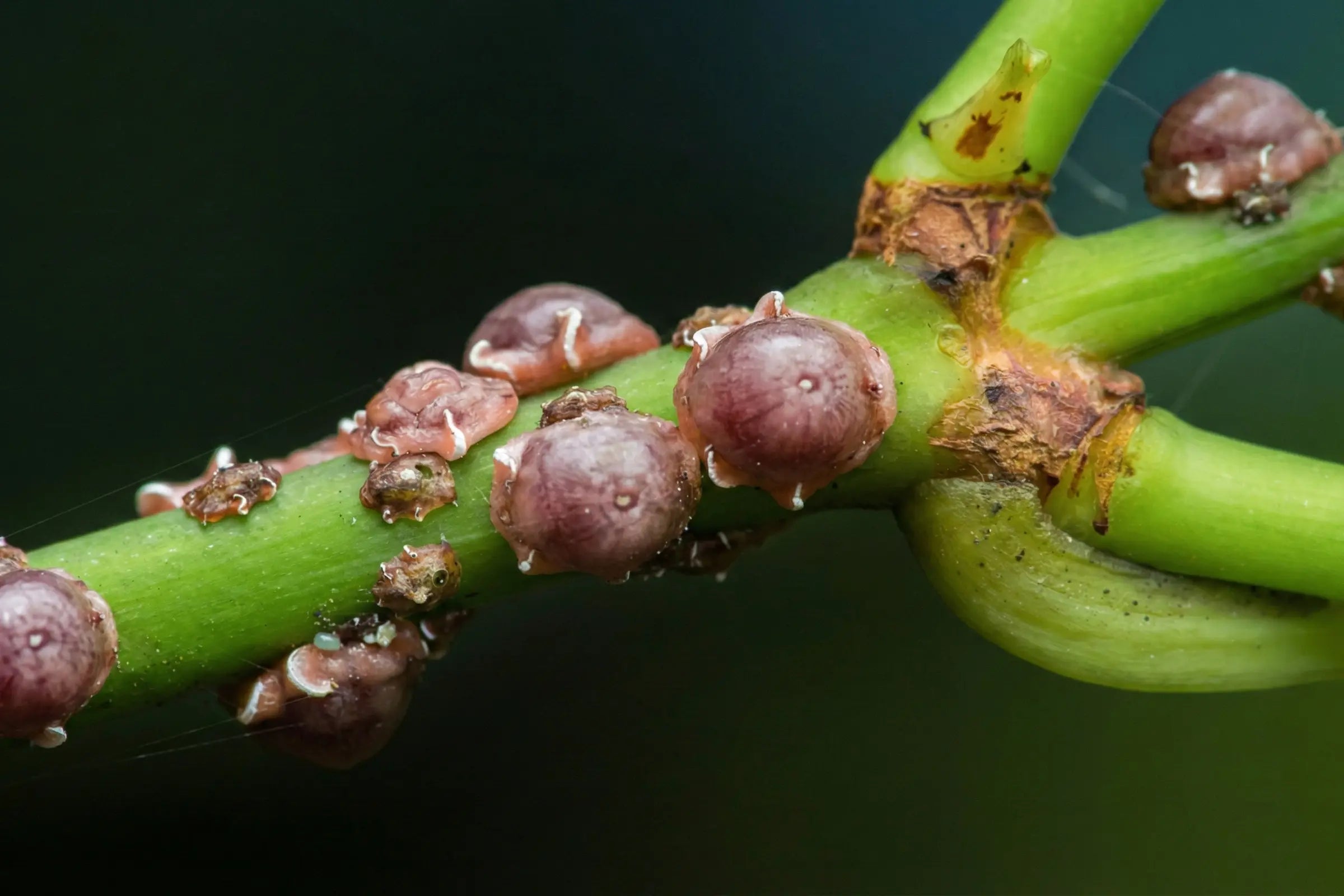
Mealybugs are soft-bodied scale insects that feed by inserting needle-like mouthparts directly into plant tissue and extracting sap. Their white waxy coating is not cosmetic — it is a functional defense mechanism that protects them from dehydration and makes certain treatments less effective on contact.
They reproduce in continuous overlapping cycles. At any given moment, an infested plant may host eggs, newly hatched nymphs, mobile crawlers, and mature adults simultaneously. Treatment that stops at visible adults leaves the next generation untouched. Breaking the cycle requires sustained, repeated effort over several weeks.
They hide where treatment is hardest to reach. Leaf joints, stem intersections, the undersides of leaves, tight growing tips, and in severe cases the root zone itself. Surface treatment misses the colonies doing the most damage. Thoroughness in application matters more than the strength of any product.
They exploit environmental imbalance. Plants stressed by low light, poor airflow, dusty foliage, or inconsistent watering are significantly more susceptible to severe mealybug outbreaks. A healthy plant in a well-maintained environment is not immune — but it is harder to overwhelm. Treatment alone is not enough without correcting what invited them.
Eggs
Adult females lay eggs inside cotton-like waxy sacs, typically hidden in leaf joints and stem crevices. A single female can produce hundreds of eggs in one cycle. The sac protects the eggs from both contact treatments and physical removal — partial removal often leaves viable eggs behind.
Crawlers
The most vulnerable stage. Newly hatched nymphs are mobile, soft-bodied, and have not yet developed their full waxy coating. They disperse actively across the plant and onto nearby surfaces. Targeted treatment during this window is the most effective point of intervention in the entire cycle.
Nymphs
Crawlers settle into protected areas, begin feeding, and gradually develop their waxy coating. As the coating builds, they become increasingly resistant to surface treatments. By this stage they are already causing measurable damage — extracting sap, excreting honeydew, and beginning to weaken the plant tissue around them.
Adults
Fully matured mealybugs are well-protected and actively reproducing. Females begin laying new egg masses, restarting the cycle. This is typically the stage that makes the infestation visible to the naked eye — which means that by the time most people notice them, at least one full generation has already completed development.
What They Do
The two ways mealybugs damage your plant
Mealybugs harm plants through continuous sap extraction — and through a secondary byproduct that creates its own set of compounding problems. Left untreated long enough, a moderate infestation becomes a structural issue that affects root development, photosynthesis, and the plant's ability to recover even after the insects are gone.
Direct feeding
Sap extraction reduces the plant's nutrient supply continuously. Over time this causes yellowing leaves, distorted or stunted new growth, premature leaf drop, reduced structural vigor, and slowed root development. The damage compounds with each generation that completes its cycle uninterrupted.
Honeydew and sooty mold
As mealybugs feed, they excrete a sticky residue called honeydew that coats leaf surfaces and accumulates on the soil and surfaces below the plant. This residue attracts ants, blocks light from reaching the leaf, and encourages sooty mold — a black fungal layer that further impairs photosynthesis and signals a long-established infestation.
New growth distortion
Mealybugs tend to concentrate on the softest, most active tissue — the growing tips. Feeding here distorts emerging leaves before they fully develop. Twisted, crinkled, or unusually small new growth is often one of the earliest visible signs that mealybugs are present before colonies become obvious to the eye.
Root-level damage
In severe cases, mealybugs move into the root zone. Root mealybugs are harder to detect and rarely resolved by foliar treatment alone. Signs include persistent decline despite surface treatment, white cottony residue in the soil, and roots that appear covered in a powdery or waxy coating when the plant is removed from its pot.
Treatment Protocol
Four steps, executed in sequence
Effective mealybug treatment requires both removing what is present and interrupting what is coming. These steps work together — each one setting up the next. Skipping or shortcutting any of them is the most common reason infestations return after what appeared to be a successful treatment.
Isolate immediately
Move the affected plant away from all others before doing anything else. Crawlers spread through direct contact between foliage, contaminated tools, and shared surfaces. A plant that appears unaffected today may already have crawlers on it if it has been in contact with an infested one. Isolation is containment — not optional.
Manual reduction
Physically remove visible colonies, egg sacs, and honeydew residue before applying any product. A damp cloth or soft brush works well for stems and nodes. Reducing the surface population improves the penetration and effectiveness of whatever treatment follows — and removes a reproductive source immediately. Be thorough; speed matters less than coverage.
Apply insecticide — and repeat
Apply to all foliage including undersides, stem joints, crevices, and growing tips. One application is never sufficient. Repeat on the schedule recommended by the product — typically every 7 to 10 days for at least three cycles — to catch each new wave of crawlers as they hatch. Stopping early is the most common reason mealybugs return. See product recommendations below.
Inspect the root zone
If the infestation persists despite thorough foliar treatment, check for root mealybugs. Carefully remove the plant from its pot and inspect the root system. White cottony residue on roots or in the soil confirms root-level infestation. This stage requires soil replacement and direct root treatment — foliar application will not reach the root zone effectively.
What We Use
Three products for a complete treatment
Insecticidal Soap
Works by disrupting the cell membranes of soft-bodied insects on contact. Effective on crawlers and nymphs before their waxy coating fully develops — making it particularly valuable for catching mealybugs mid-cycle. Apply thoroughly and repeat consistently. Safe for most indoor plants when used as directed and less disruptive to the environment than synthetic alternatives.
Recommended on Amazon
Insecticidal Supersoap
Neem Oil
A naturally derived oil that disrupts the mealybug life cycle across multiple stages. Works as both a contact treatment and a deterrent that interferes with molting and reproduction. Apply in the evening or early morning to avoid leaf stress. Particularly effective when alternated with insecticidal soap over a multi-week treatment schedule — each product hits the cycle differently.
Recommended on Amazon
Neem Oil Concentrate
Electric Sprayer
Coverage is the limiting factor in most mealybug treatments. A fine, even mist reaches the undersides of leaves, deep into stem joints, and into the densest parts of the canopy far more effectively than a hand-pump sprayer. For larger indoor trees with established canopies, an electric sprayer is the difference between thorough coverage and a treatment that misses the most protected colonies.
Recommended on Amazon
Electric Garden Sprayer
What Not To Do
Precision and consistency outperform aggression
Most recurring mealybug infestations are not the result of ineffective products. They are the result of specific, avoidable mistakes in how treatment is applied or followed through. Identifying these patterns is often more useful than any product recommendation, because the right products fail without the right approach behind them.
- Treating only once — A single application reduces the visible population but leaves eggs and developing nymphs intact. The next generation hatches into an untreated environment and the cycle restarts within weeks.
- Missing undersides of leaves — The most common application gap. Mealybug colonies on leaf undersides and in crevices go entirely untouched by surface-only treatment. Every application must be thorough.
- Ignoring environmental stress — Mealybugs exploit weakness. A plant treated but left in low light, poor airflow, or dusty conditions will continue to be vulnerable. Correction of the environment is part of the treatment plan.
- Failing to isolate early — Waiting to isolate until the infestation is confirmed on multiple plants makes containment exponentially harder. Isolate at the first sign, not the last.
- Overusing harsh chemicals — Stronger is not better when it comes to indoor plants. Systemic pesticides can damage root systems and soil biology. Targeted, repeated application of appropriate products consistently outperforms aggressive single-treatment approaches.
Every plant we place is built to last in its environment. When something like mealybugs appear, it is a signal worth taking seriously. We are always here to help you address it before it escalates.
Explore Plant Maintenance