
How to Care for Your Brachychiton populneus (Kurrajong Tree)
Care Guide
Brachychiton
populneus
The Kurrajong — an Australian semi-evergreen with remarkably variable leaf forms, a progressively thickening trunk, extreme drought tolerance, and a quiet architectural character that rewards patient, long-term care.
The Plant
Variable leaf.
Drought-tolerant architecture.
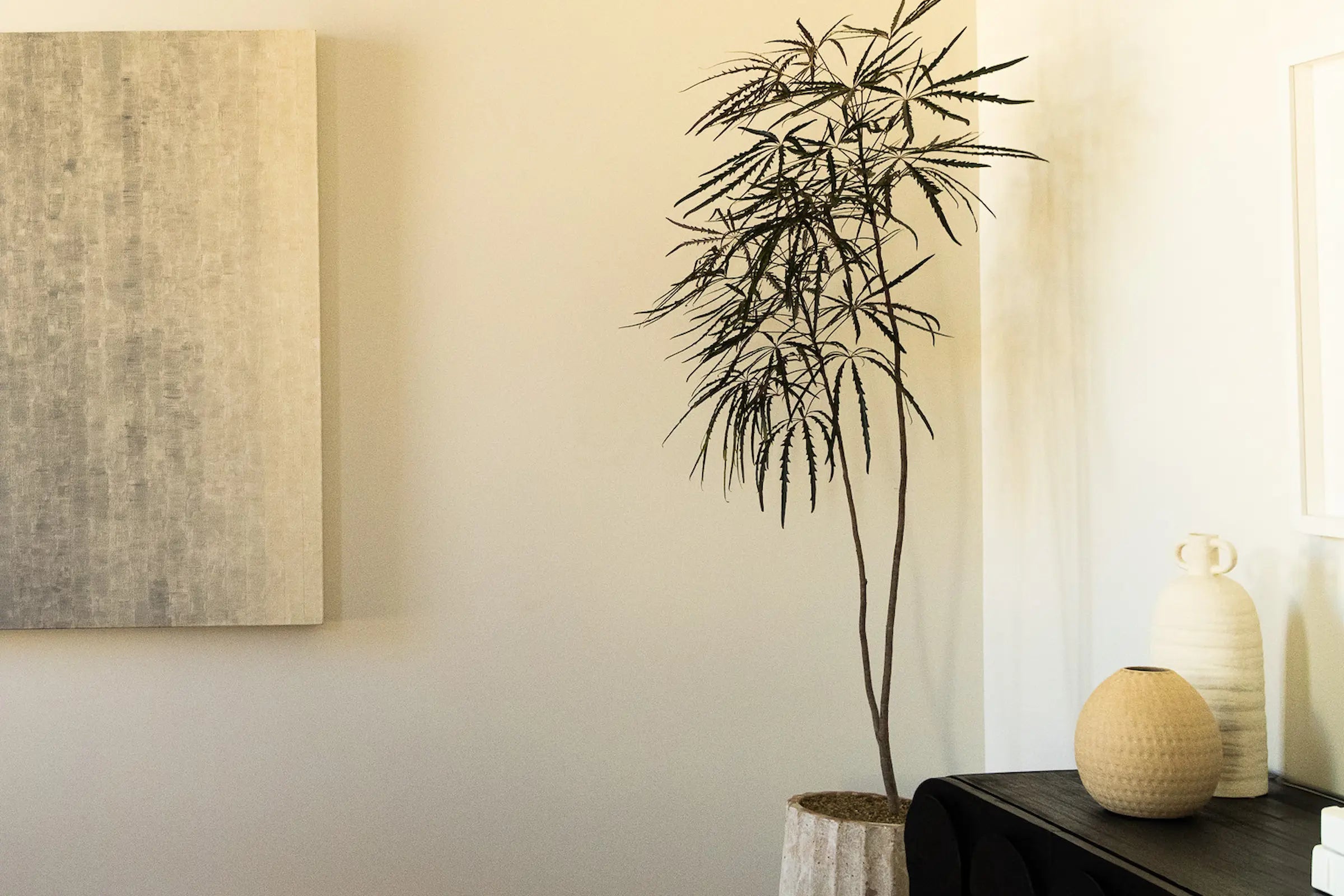
Native to the semi-arid inland regions of eastern Australia, the Brachychiton populneus is one of the most drought-tolerant trees available for Southern California conditions. It is semi-evergreen — retaining its leaves through most of the year but capable of dropping them under severe drought or cold stress — and produces a remarkable range of leaf forms on a single tree: from simple oval to deeply lobed, three- to five-part forms that look nothing alike on adjacent branches.
As a container specimen it develops a thickening, characterful trunk over years that becomes the most architecturally compelling feature of the plant. Given good light, appropriate dry cycles, and patient care, it becomes a quietly extraordinary long-term tree for a bright interior or sunny outdoor position.
At a Glance
Light & Placement
The Kurrajong thrives in bright, open sun outdoors and performs well in the brightest interior positions when used as a container specimen. A south-facing window with several hours of direct sun is ideal indoors. Unlike the acerifolius, the populneus is semi-evergreen rather than fully deciduous — it retains its leaves through most conditions, dropping them only under significant drought or cold stress, which makes it somewhat more adaptable to interior use.
For outdoor use it is one of the most drought-tolerant and sun-tolerant street trees available in the Australian flora. For interior use, maximize the light available. See our Interior Plant Placement Guide.
Watering & Reading the Plant
Allow the soil to dry significantly between waterings — to the halfway point of the container or deeper before rehydrating. The Kurrajong is extremely drought-tolerant once established, storing reserves in its thickening trunk. Water thoroughly when you do water, then allow a full dry cycle to complete. Every ten to fourteen days in the active season; monthly in winter. See our guide on how to know when to water your plants.
Well Hydrated
Leaves are held firmly. The soil still holds residual moisture at depth. No water needed — continue the current dry interval.
Ready to Water
Soil is dry to at least halfway down. Leaves may show slight reduction in their usual crispness. Water slowly and thoroughly.
Overwatered
Stop watering immediately. Soft or yellowing leaves while soil remains wet indicate overwatering. Allow extended drying.
The Variable Leaf Form
One of the most distinctive qualities of the Brachychiton populneus is the remarkable variability of its leaf form — a single tree can produce leaves that range from simple oval shapes to deeply three- to five-lobed forms that resemble nothing so much as oversized ivy leaves. This variability is entirely normal and is not a sign of stress or inconsistent care.
In cultivation as an interior specimen, the populneus develops a progressively thickening, characterful trunk over years and a canopy of this variably shaped foliage that produces a genuinely interesting texture from up close. The trunk, which is the developing storage organ, becomes the most compelling visual element of the plant as it matures.
Temperature & Humidity
The Kurrajong is highly cold-tolerant — established specimens can handle temperatures near freezing with minimal damage. In Southern California it is appropriate as a year-round outdoor tree in virtually all zones. As an indoor specimen it tolerates the temperature range of a well-maintained interior without difficulty.
Humidity needs are very low — it evolved in the semi-arid inland regions of Australia and is adapted to dry air. Standard household air is entirely appropriate without supplemental intervention.
Fertilizing
Feed with a balanced liquid fertilizer at half strength once a month during spring and summer. The Kurrajong evolved in lean soils and does not need or benefit from heavy feeding. Consistent light feeding through the growing season is more beneficial than periodic heavy application. Stop feeding in fall and winter during the slower growth period.
For the complete approach to indoor fertilizing, see our guide on fertilizing indoor plants properly.
Pruning & Shaping
Prune in late winter or early spring before the main growing flush. The Kurrajong responds well to shaping and can be kept to container scale with regular tip pruning that encourages branching below the cut. Remove any dead, crossing, or poorly positioned branches cleanly at their origin.
The trunk development is the most architecturally interesting aspect of this tree over time — shaping decisions that expose more of the developing trunk character while maintaining a balanced canopy above are generally the most visually rewarding approach. See our pruning guide for the full technique.
Repotting
Repot every two to three years in spring. Use a quality well-draining potting mix with perlite added. Size up by one container. The developing trunk and root system benefit from progressive container sizing that gives the storage organs room to expand without placing them in an excessively large volume of soil.
Propagation: From seed, which germinates readily in warm conditions. Handle seed pods with gloves — the pod interiors contain fine irritating fibers similar to those of the acerifolius. Seed-grown trees take several years to develop the trunk character that makes this species interesting.
Common Issues
The Brachychiton populneus is one of the most robust and drought-tolerant species in this collection. Problems are rare when basic light and drainage requirements are met.
Variable Leaf Shapes
Completely normal for this species — a single tree produces leaves ranging from simple ovals to deeply lobed forms. No action needed. This variability is a characteristic of the species, not a sign of stress.
Leaf Drop
Under severe drought or cold stress the populneus will drop its leaves. Restore appropriate conditions and new growth will resume. Minor leaf drop during environmental adjustment is normal.
Slow Growth
Insufficient light or overly frequent watering both slow this tree significantly. Maximize sun exposure and allow adequate drying between waterings.
No Trunk Thickening
The trunk thickens gradually over years in appropriate conditions. Maximize light, allow proper drought cycles, and give the plant time — trunk development cannot be accelerated.
Fine webbing and stippling on leaf surfaces in dry conditions. Treat with neem oil or insecticidal soap applied to all surfaces. Repeat weekly for three to four weeks.
White cottony deposits at leaf axils and branch junctions. Treat with isopropyl alcohol on a cotton swab then follow with neem oil. Repeat weekly.
Inspect neighboring plants immediately. Scrape away manually and treat all surfaces with neem oil. Repeat weekly for a full month.
Dust on Leaves
The broad leaf surfaces collect dust and reduce photosynthetic efficiency over time. Wipe gently with a soft damp cloth, top and underside. Do not use leaf shine products. Regular cleaning also lets you detect early pest activity before it spreads.
Growth & Lifespan
The Brachychiton populneus is a long-lived, drought-tolerant tree that becomes progressively more architectural and interesting as its trunk develops character over years. In the Australian interior it is used as a shade tree, a windbreak, and drought-time fodder for livestock — a testament to both its resilience and its utility.
As an interior or container specimen it is valued for exactly the opposite reason: its structural development, the variability of its foliage, and the progressive revelation of trunk character make it more compelling the older it gets and the more patiently it has been cared for.
The Plant Daddies Society
Let us handle
the care.
Weekly expert visits, full plant protection, and a living collection that grows with you. The Society takes the guesswork out of plant ownership entirely.
%0A%0A%0A%0A%0A%0A%20%20%0A%0A%20%20Care%20Guide%0A%20%20Brachychitonpopulneus%0A%0A%20%20The%20Kurrajong%20%E2%80%94%20an%20Australian%20semi-evergreen%20with%20remarkably%20variable%20leaf%20forms,%20a...)