
How to Care for Your Pachypodium lamerei (Madagascar Palm)
Care Guide
Pachypodium
lamerei
The Madagascar Palm — a tall, columnar succulent from southern Madagascar with a dramatically spiny trunk, a terminal rosette of dark green leaves, and spectacular large white flowers on mature specimens.
The Plant
The spiny column.
Madagascar drama.
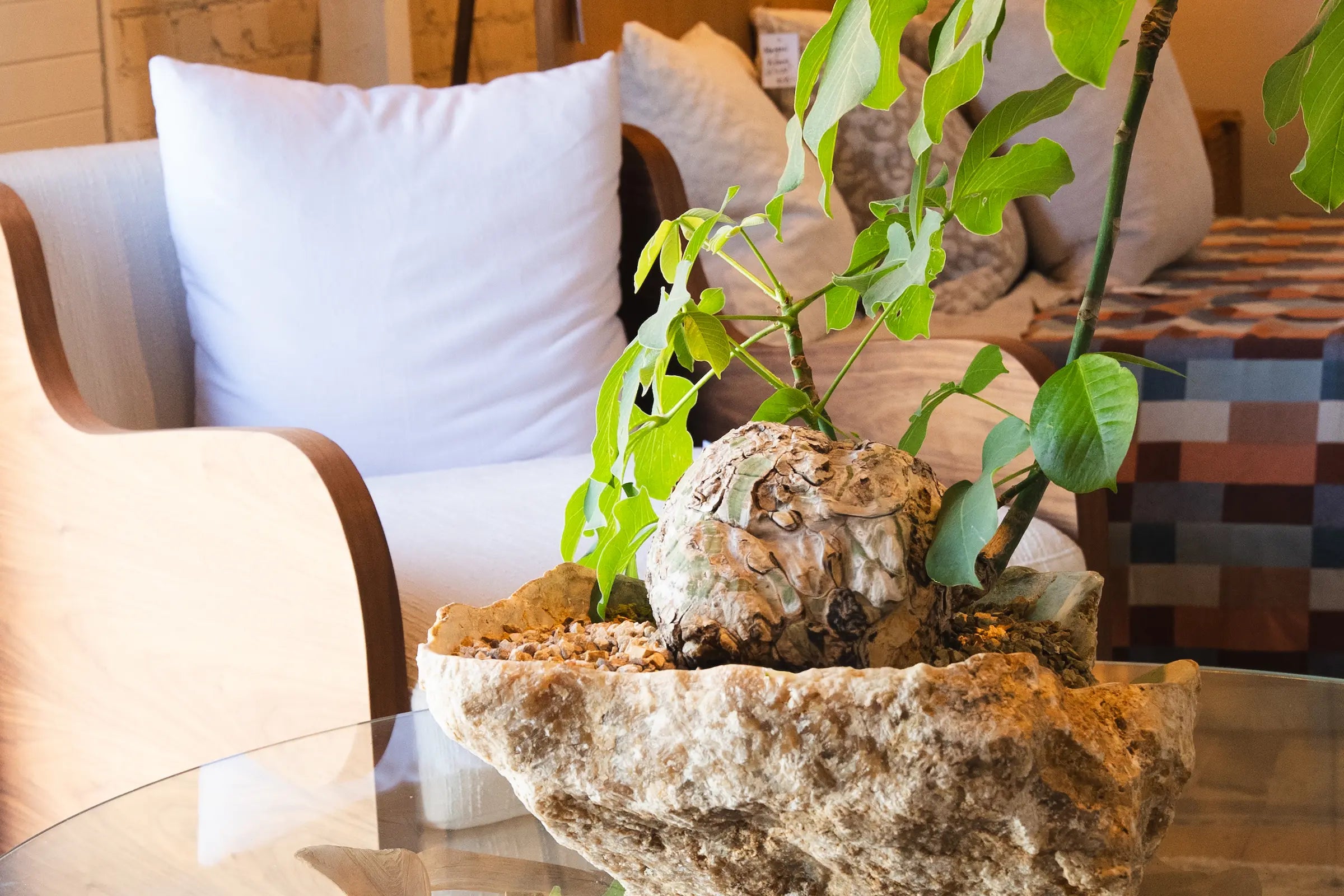
Native to the dry thorny bush of southern Madagascar, the Pachypodium lamerei is one of the most dramatic succulent trees available for interior collections. It grows as a tall column covered in clusters of rigid three-part spines, topped by a terminal rosette of long, dark green leaves that is shed each winter and renewed each spring. In mature specimens, spectacular large white flowers appear from the growing tip, filling the room with fragrance.
It is a plant that demands maximum direct sun and disciplined restraint with water, and rewards both with steady upward growth and an increasingly impressive trunk that becomes more characterful with each passing year. Handle with thick leather gloves at all times — the spines are rigid, sharp, and arranged at every height along the trunk.
At a Glance
Light & Placement
The Madagascar Palm requires maximum light — a south-facing window with full, unobstructed direct sun for as many hours daily as your space allows. Native to the dry thorny bush of southern Madagascar, it evolved in some of the most intense, unfiltered sun conditions available on earth and carries those requirements directly into cultivation. In strong direct light it develops its characteristic white flower crown, maintains the compact spacing between leaf flushes, and develops its impressive spiny trunk. In lower light growth slows dramatically and flowering becomes impossible.
Position it at the glass, not set back from the window. For a framework on evaluating interior light levels, see our Interior Plant Placement Guide.
Flowering requires full sun. The large, fragrant white flowers that make the Pachypodium so spectacular only appear in mature specimens receiving maximum direct sun. Insufficient light is the single most common reason flowering never occurs.
Watering & Reading the Plant
Allow the soil to dry completely between waterings. The Pachypodium lamerei stores water and nutrients in its thick, spiny trunk and is adapted to the extreme dry seasons of Madagascar where rain may not fall for months. In the active growing season, every two to three weeks is typically appropriate. In winter when the plant may drop its leaves and enter dormancy, water very sparingly — once a month or less. See our guide on how to know when to water your plants.
Well Hydrated
The trunk feels firm and fully turgid. Leaves, if present, are held firmly. Soil is completely dry. If dryness is complete but trunk is firm, wait a few more days.
Ready to Water
The trunk feels marginally softer than at peak hydration. Leaves may show slight reduction in tension. The soil is completely dry when probed throughout. Water slowly and deeply, then allow a complete dry cycle.
Overwatered
Stop all watering immediately. Soft, dark, or mushy tissue at the trunk base indicates rot from sustained moisture. Allow extended drying and inspect the root zone before resuming any watering.
The Spiny Trunk
The Pachypodium lamerei's trunk is covered in clusters of three-part spines that run the full height of the column in spiraling arrangements. These spines are functional — they are an adaptation to the browsing pressure of large herbivores in Madagascar — and they make handling the plant one of the most careful operations in a plant collection. Handle by the container, never by the trunk.
The trunk itself is the water storage organ, expanding and contracting slightly with the plant's hydration cycle. A well-hydrated trunk is round and firm in cross-section; a trunk beginning to need water shows slight flattening of the sides. This is a more subtle indicator than the severe wrinkling seen in some succulents, but reliable with familiarity. The leaves emerge from the top of the trunk in a terminal rosette that is shed each winter when the plant enters dormancy and replaced each spring.
Temperature & Humidity
The Madagascar Palm prefers hot, dry conditions — 65 to 100 degrees Fahrenheit — and is cold-sensitive. It should not be exposed to temperatures below 50 degrees Fahrenheit for any sustained period. Wet cold is acutely dangerous — the trunk rots rapidly when cold and moist simultaneously. Ensure the soil is completely dry before any cold weather arrives.
Humidity requirements are minimal. Standard dry interior air is not just acceptable but preferable for this species. Avoid any supplemental humidity — the fine spines and trunk surface perform best in dry conditions that prevent fungal issues from developing in the tight spine clusters.
Fertilizing
Feed monthly during spring and summer with a balanced liquid fertilizer at half strength or a cactus-specific formula. The Pachypodium evolved in nutrient-lean soils and does not need or benefit from heavy feeding. During the period when flower buds are forming, a fertilizer with slightly higher phosphorus can support bloom development.
Stop feeding entirely through fall and winter dormancy. Resume in spring when new leaves begin to emerge from the trunk tip. For the complete approach to indoor fertilizing, see our guide on fertilizing indoor plants properly.
Pruning & Maintenance
The Pachypodium lamerei cannot be pruned in any conventional sense — cutting the growing tip is fatal to the plant. The only maintenance is removal of spent flower stalks after blooming and clearing of any dead leaf bases from previous seasons that remain attached to the trunk.
Wear very thick leather gloves when working near this plant — the three-part spines are rigid and sharp enough to penetrate standard gardening gloves. Handle the container by its base, not the plant itself, for any repositioning. See our pruning guide for the general approach to maintenance.
Repotting
Repot every two to three years in spring when new leaf growth is actively emerging. Use an extremely fast-draining cactus mix with 40 to 50 percent perlite or coarse grit added. Wear thick leather gloves and long sleeves — repotting a Pachypodium requires full skin protection from the spines. After repotting, wait two weeks before watering.
Propagation: From seed, which germinates readily in warm, moist conditions. Young seedlings are initially spineless and develop their characteristic spines progressively over the first few years. The trunk swelling that defines mature specimens develops over years — patience is essential for this species above almost all others.
Common Issues
Most problems with the Pachypodium lamerei trace to overwatering causing trunk rot — by far the most serious issue this species faces — or insufficient light preventing the growth and flowering that are the reasons to own it.
Trunk Base Rot
The most serious issue for this species. Soft, dark, or mushy tissue at the trunk base caused by overwatering, especially combined with cool temperatures. Stop all watering immediately. Allow complete drying. Remove affected tissue with clean cuts and repot in fresh, very fast-draining mix.
Winter Leaf Drop
Normal and expected annually. The Pachypodium is deciduous, dropping its terminal rosette of leaves each fall and re-leafing each spring. Do not water in response. Reduce to very sparing watering through the leafless dormancy period.
No Flowering
Maximum direct sun is required for reliable flowering, typically in specimens at least five to seven years old. Insufficient light is the most common cause in younger, non-flowering plants. Improve light position and allow several years for the plant to reach flowering maturity.
Spine Yellowing
Yellowing or darkening of the spine clusters may indicate fertilizer salt accumulation or root stress. Flush the container thoroughly with plain water and ensure drainage is functioning correctly.
Fine webbing and stippling on leaf surfaces in dry conditions. The terminal leaf rosette is the primary habitat. Treat with neem oil or insecticidal soap applied carefully, avoiding soaking the spine clusters. Repeat weekly for three to four weeks.
White deposits at the base of the terminal leaves where they emerge from the trunk. Probe carefully with a cotton swab — access is limited by the surrounding spines. Treat with isopropyl alcohol then follow with neem oil. Repeat weekly.
Inspect neighboring plants immediately. Use a small brush to apply neem oil around the spine structures. Repeat weekly for a full month. Wear thick gloves throughout.
Dust on Leaves
The terminal leaf rosette collects dust. Use a very soft dry brush to clean between and along the leaves. Do not wet or spray the leaves near the trunk crown where moisture can collect against the trunk surface.
Growth & Lifespan
The Pachypodium lamerei grows steadily in maximum light — adding centimeters to the trunk height each season and gradually developing the impressive scale that makes mature specimens so dramatic. In its native Madagascar it can reach up to six meters in height with a trunk diameter of 60 centimeters or more.
In cultivation the growth is slower but the trajectory is the same: upward, steadily, season by season, the spiny trunk growing more impressive and the seasonal flowering event more spectacular with each passing year. Given maximum direct sun, disciplined dry watering cycles, and patient care, this becomes one of the most extraordinary interior specimens available.
The Plant Daddies Society
Let us handle
the care.
Weekly expert visits, full plant protection, and a living collection that grows with you. The Society takes the guesswork out of plant ownership entirely.
%0A%0A%0A%0A%0A%0A%20%20%0A%0A%20%20Care%20Guide%0A%20%20Pachypodiumlamerei%0A%0A%20%20The%20Madagascar%20Palm%20%E2%80%94%20a%20tall,%20columnar%20succulent%20from%20southern%20Madagascar%20with%20a%20dramati...)