
How to Care for Your Pseudobombax elipticum (Shaving Brush Tree)
Care Guide
Pseudobombax
ellipticum
The Shaving Brush Tree — a deciduous tropical caudiciform from Mexico and Central America that produces one of the most spectacular flowering events of any interior plant: explosions of hundreds of silky pink-purple stamens on bare winter branches.
The Plant
The bare-branch spectacle.
Shaving brush blooms.
Native to the dry tropical forests of Mexico, Central America, and northern South America, the Pseudobombax ellipticum is grown in cultivation for one transcendent reason: the flowering event. In late winter to early spring, before the large palmate leaves emerge, the bare branches produce enormous flower buds that open into explosions of hundreds of long, silky, pinkish-purple stamens — looking precisely like an enormous, outrageously beautiful shaving brush at full extension. Each flower can reach 30 centimeters across. A mature specimen in full bloom is one of the most genuinely extraordinary sights available in interior horticulture.
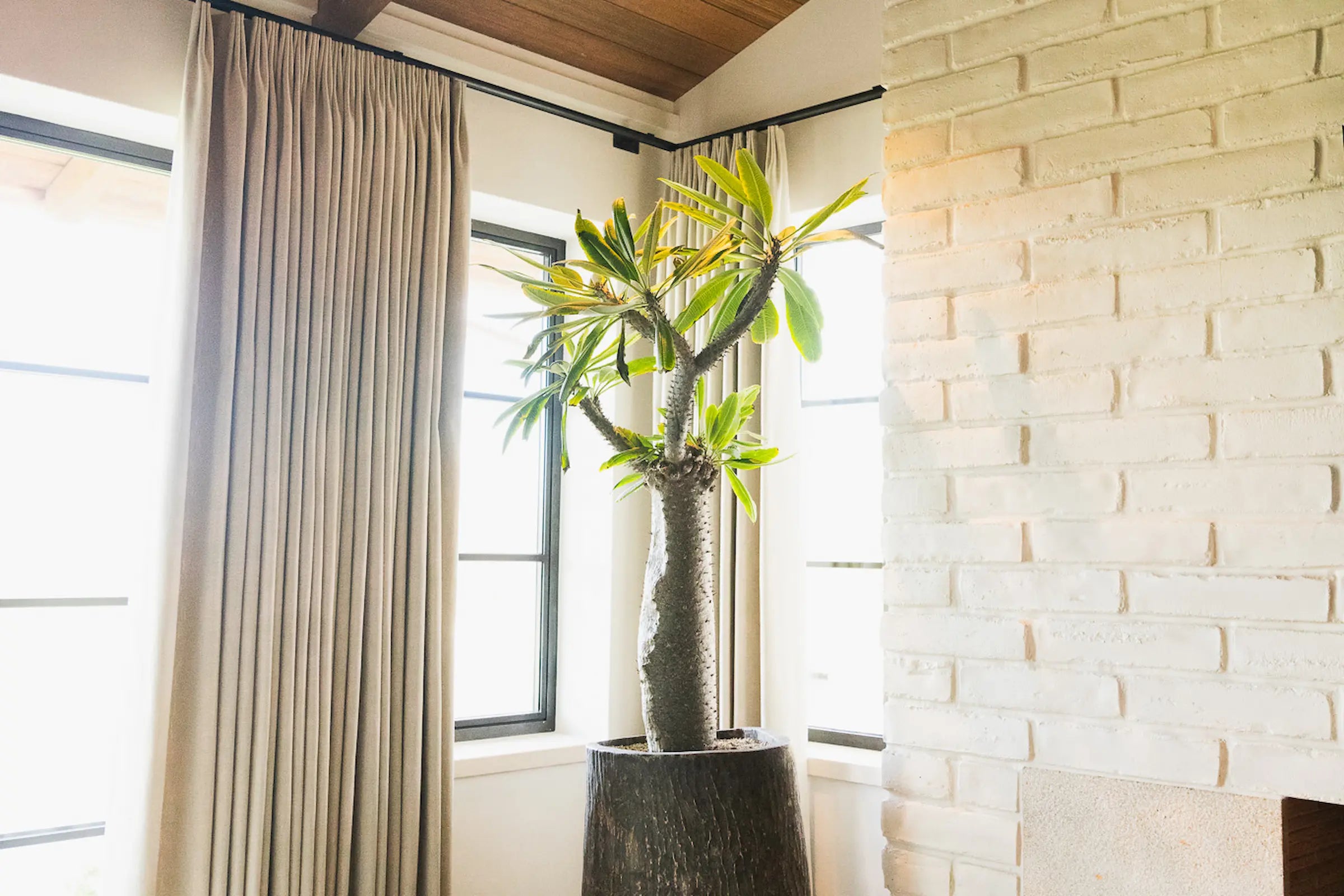
The rest of the year it is a handsome, palmate-leafed deciduous tree with a progressively swelling, green-barked trunk. The flowering is the event — and it is worth every year of patient, bright-light, appropriate-rest care required to produce it.
At a Glance
Light & Placement
The Shaving Brush Tree requires very bright light — a south-facing window with several hours of direct or strong indirect light daily. Native to the dry forests and tropical woodlands of Mexico, Central America, and northern South America, it evolved in conditions of high light and pronounced seasonal drought. In strong light it maintains its compact, developing form and flowers reliably in season. In lower light growth becomes weak and the spectacular flowering that is the plant's defining event becomes unreliable or absent.
Position it in your brightest available interior location. The flowering event requires that the light needs be met without compromise. See our Interior Plant Placement Guide.
Watering & Reading the Plant
Allow the soil to dry almost completely between waterings. The Pseudobombax ellipticum stores water in its swelling, green trunk and tolerates extended dry periods between waterings. In the active growing and flowering season (late winter through summer) water every two to three weeks. In the dry rest period (fall through early winter) reduce to once a month or less. The trunk is the primary diagnostic: firm and full means well-hydrated; marginally softer indicates time to water. See our guide on how to know when to water your plants.
Well Hydrated
The palmate leaves are held firmly. The trunk feels full and turgid. No water needed — continue the dry interval.
Ready to Water
The trunk feels marginally softer than fully hydrated. The soil is completely dry when probed. Water slowly and deeply, then allow a complete dry cycle.
Overwatered
Stop watering immediately. Soft tissue at the trunk base indicates rot. Allow extended drying before resuming.
The Spectacular Shaving Brush Flower
The Pseudobombax ellipticum earns its common name from what is arguably the most spectacular flowering event of any deciduous interior tree: before the leaves emerge in late winter to spring, the bare branches produce enormous, dramatic flower buds that open into explosions of hundreds of long, silky, pinkish-purple stamens — looking exactly like an enormous shaving brush in full display. Each individual flower can reach 20 to 30 centimeters across when fully open.
The flowering occurs on bare branches — the same spectacular-on-bare-stems timing as the Brachychiton acerifolius — and lasts for several days per flower. A mature Pseudobombax in full bloom is one of the most extraordinary things that can occur in an interior plant collection, entirely worth the years of patient bright-light care required to produce it. After flowering, the large, palmate leaves emerge and hold through the growing season before dropping in fall.
Temperature & Humidity
The Shaving Brush Tree prefers warm conditions — 65 to 95 degrees Fahrenheit — and is cold-sensitive below 45 degrees Fahrenheit. The pronounced dry and cool rest period in fall and early winter is essential for triggering the spectacular winter-to-spring flowering event — this mimics its native dry season. Maintain a cool, dry period from fall through early winter, then resume watering in late winter as buds begin to show.
Humidity needs are moderate during the growing season and very low during the rest period. Standard interior air is appropriate throughout the year.
Fertilizing
Feed monthly during spring and summer with a balanced liquid fertilizer at half strength. Stop feeding in fall when the plant enters its dry rest period. Resume in spring as flowering concludes and new leaves emerge. A fertilizer with higher phosphorus during the spring growing period supports good trunk development and sets up the following season's flowering. See our guide on fertilizing indoor plants properly.
Pruning & Shaping
The Pseudobombax ellipticum requires minimal pruning — its natural branching habit develops attractively without intervention. Remove any dead or crossing branches cleanly in late winter before the flowering event begins. Light tip pruning after flowering encourages branching that provides more flowering sites the following season.
See our pruning guide for the general technical approach.
Repotting
Repot every two to three years in late winter before the flowering event, or in spring after flowering has concluded. Use a fast-draining potting mix with perlite added. Size up by one container. The trunk stores reserves — do not damage it during repotting.
Propagation: From seed, which germinates readily in warm, moist conditions. Cuttings are possible but the trunk character that makes this species so compelling only fully develops from seed-grown plants over years.
Common Issues
No Flowering
Most commonly caused by insufficient light or failure to provide a dry, cool rest period in fall and early winter. Maximize light year-round and ensure a clear dry rest before the flowering trigger.
Trunk Base Softening
Stop watering immediately. Soft tissue indicates rot from sustained moisture. Allow complete drying and inspect before repotting.
Leaf Drop (Fall)
Normal and expected — the Pseudobombax is deciduous and drops its leaves in fall before the winter rest and flowering period. Do not increase watering in response.
Weak or Slow Growth
Insufficient light. Move to maximum available direct or strong indirect sun.
Fine webbing on leaf surfaces in the growing season. Treat with neem oil applied to all surfaces. Repeat weekly for three to four weeks.
White deposits at leaf axils and branch junctions. Treat with isopropyl alcohol then follow with neem oil. Repeat weekly.
Inspect neighboring plants immediately. Treat with neem oil. Repeat weekly.
Dust on Leaves
The broad leaf surfaces collect dust and reduce photosynthetic efficiency over time. Wipe gently with a soft damp cloth, top and underside. Do not use leaf shine products. Regular cleaning also lets you detect early pest activity before it spreads.
Growth & Lifespan
The Pseudobombax ellipticum is a long-lived, deciduous caudiciform tree that becomes more extraordinary with each passing year — the trunk thickening, the branching structure becoming more complex, and the annual flowering event becoming more spectacular as more flowers are produced on the increasingly branched canopy.
Given maximum light, the correct seasonal rest period, and patient care over years, it becomes one of the most extraordinary flowering specimens available for any interior collection — a plant whose annual display of shaving-brush flowers on bare branches is among the most spectacular events that can occur in an interior space.
The Plant Daddies Society
Let us handle
the care.
Weekly expert visits, full plant protection, and a living collection that grows with you. The Society takes the guesswork out of plant ownership entirely.
%0A%0A%0A%0A%0A%0A%20%20%0A%0A%20%20Care%20Guide%0A%20%20Pseudobombaxellipticum%0A%0A%20%20The%20Shaving%20Brush%20Tree%20%E2%80%94%20a%20deciduous%20tropical%20caudiciform%20from%20Mexico%20and%20Cen...)