
How to Care for Your Cyphostemma juttae (Wild Grape)
Care Guide
Cyphostemma
juttae
The Cabbage Grapevine — a large, sun-demanding caudiciform from the Namib desert margins with a massive pale-barked trunk, continuously peeling papery bark, and large blue-green compound leaves on vigorous seasonal vines.
The Plant
The Namib trunk.
Desert extreme.
From the extremely arid margins of the Namib desert in Namibia, the Cyphostemma juttae is the most dramatically large of the commonly cultivated Cyphostemma species. It develops a trunk base of astonishing eventual scale — pale, yellowish-green, covered in continuously peeling papery bark — from which large, distinctly glaucous-blue compound leaves emerge in the growing season on vigorous vines.
It is a plant for the committed — one that asks for maximum direct sun and extreme restraint with water, and delivers in return one of the most extraordinary large caudiciform forms available in indoor cultivation. Given its specific requirements over years, it becomes genuinely irreplaceable in any serious collection.
At a Glance
Light & Placement
The Cabbage Grapevine requires maximum direct sun — a south-facing window with several hours of unobstructed direct light daily. Like the cirrhosum, it is a sun-demanding caudiciform from southern Africa that carries its high-light requirements directly into cultivation. In strong direct light it maintains compact growth and develops the swelling trunk that is its primary visual asset. Insufficient light produces weak, leggy vines and prevents the trunk from developing at its best rate.
Position it at the glass, not back from the window. See our Interior Plant Placement Guide for a practical assessment framework.
Watering & Reading the Plant
Allow the soil to dry completely between waterings. The Cyphostemma juttae is a large caudiciform from the extremely arid Namib desert margins and carries an even higher drought tolerance than the cirrhosum. In the active growing season, every two to three weeks is typically appropriate. In winter dormancy, water once a month or less. Confirm complete dryness by probing to the base of the container before rehydrating. See our guide on how to know when to water your plants.
Well Hydrated
The thick, glaucous leaves are held with full tension and the caudex feels firm throughout. No water needed — continue the dry interval.
Ready to Water
The caudex feels slightly softer than at peak hydration. The soil is completely dry when probed to the base. Water slowly and deeply, then allow a complete dry cycle.
Overwatered
Stop watering immediately. Soft caudex tissue indicates rot. Extended drying and root inspection before any further water are essential.
The Giant Caudex & Blue-Green Leaves
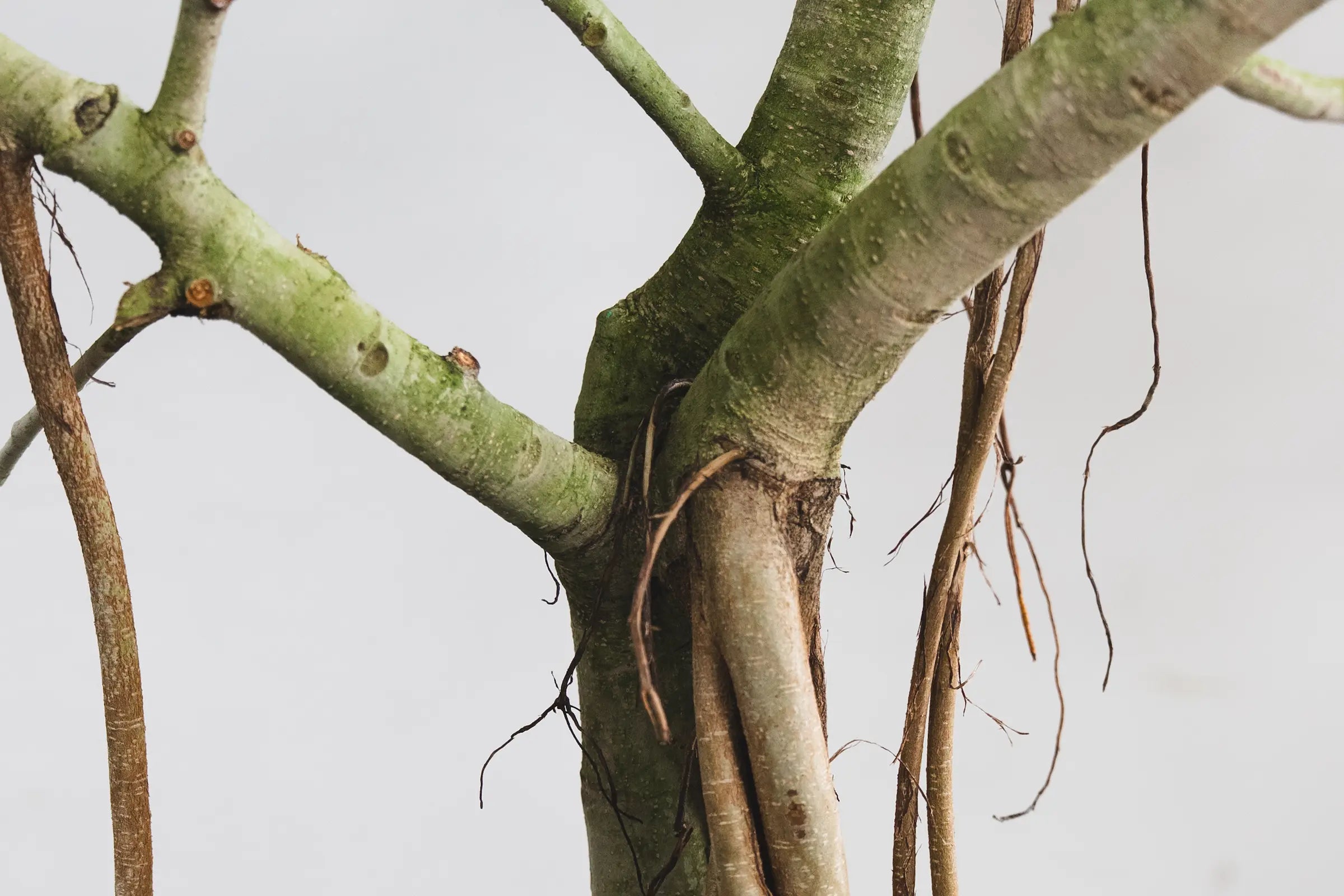
The Cyphostemma juttae is the largest of the commonly cultivated Cyphostemma species — in its native Namib margins it develops trunk bases of astonishing size, with the largest specimens approaching the scale of small trees. The bark is pale, yellowish-green, and peels in papery strips that reveal fresh bark beneath in a process similar to the Bursera species. The leaves are large, compound, and distinctly glaucous-blue in color — a dramatic contrast to the pale trunk.
In cultivation this combination — the massive pale trunk, the peeling bark, and the large blue-green compound leaves above — creates one of the most extraordinary plant forms available in indoor horticulture. It requires patient, maximum-light care over many years to reach its full potential, but even young specimens are visually compelling from the first season.
Temperature & Humidity
The Cyphostemma juttae is from the extremely arid margins of the Namib desert — one of the driest environments on earth — and reflects those origins in its extreme drought tolerance and preference for very low humidity. It prefers warm conditions — 65 to 100 degrees Fahrenheit — and handles the hottest conditions a Southern California summer can produce without stress.
Cold sensitivity is real — the Namib margins experience warm days but the combination of cold and moisture is fatal. Ensure the soil is completely dry before any cold event. Standard dry interior air is entirely appropriate without supplemental humidity intervention.
Fertilizing
Feed very lightly at quarter strength once a month during spring and summer only. The juttae evolved in some of the most nutrient-poor soils on earth and has extremely modest nutritional requirements. Over-fertilizing produces rapid, weak growth that dilutes the compact, structural quality of the plant. Stop feeding in fall and winter and through any dormancy period.
For the complete approach, see our guide on fertilizing indoor plants properly.
Vine Management & Pruning
The Cyphostemma juttae produces large, vigorous vines in the growing season — these can be trained, allowed to cascade, or trimmed back periodically. Wear gloves when cutting — the stems exude a latex sap. In winter when vines die back in dormancy, remove dead material cleanly. New vines will emerge in spring.
See our pruning guide for the complete technical approach.
Repotting
Repot every three to four years in spring. Use an extremely fast-draining mix — cactus and succulent blend with 40 to 50 percent additional perlite or coarse grit. Raise the caudex above the soil surface when repotting to showcase its form and prevent moisture accumulation at the base.
Propagation: From seed only. The dramatic caudex development is not achievable from cuttings. Seed germinates well in warm, well-drained conditions with consistent moisture during germination.
Common Issues
The Cyphostemma juttae is extremely robust when its specific requirements — maximum sun, very infrequent watering, completely dry soil between sessions — are met without compromise.
Caudex Softening
Rot from sustained moisture. Stop watering immediately. Unpot and remove all affected tissue with clean cuts. Allow complete drying before repotting.
Seasonal Vine Dieback
Normal winter dormancy. Remove dead material and wait for spring regrowth from the caudex surface.
Leggy Vine Growth
Insufficient light. Move to maximum direct sun and prune back leggy growth to encourage denser regrowth.
Peeling Bark
Normal and continuous — the same process as the Bursera fagaroides. Do not attempt to remove bark that is not yet ready to separate naturally. The peeling reveals fresh, pale bark beneath.
Fine webbing and stippling on the large compound leaves in dry conditions. Treat with neem oil applied carefully to all surfaces. Repeat weekly for three to four weeks.
White deposits in vine junctions and caudex crevices. Treat with isopropyl alcohol on a cotton swab then follow with neem oil. Inspect the caudex surface carefully. Repeat weekly.
Inspect neighboring plants immediately. Treat all surfaces with neem oil. Repeat weekly for a full month.
Dust on Leaves
The broad leaf surfaces collect dust and reduce photosynthetic efficiency over time. Wipe gently with a soft damp cloth, top and underside. Do not use leaf shine products. Regular cleaning also lets you detect early pest activity before it spreads.
Growth & Lifespan
In its native Namib margins the Cyphostemma juttae can live for many decades, developing trunk bases of remarkable size and presence. In cultivation the development is slower but consistent — each year of maximum sun and appropriate dry cycles adding measurably to the trunk that is the plant's primary asset.
This is a plant for the most committed collectors — one that asks for the most specific conditions (maximum direct sun, extreme restraint with water) and delivers, in return, one of the most extraordinary plant forms available in cultivation. Given the right care over years, it becomes irreplaceable.
The Plant Daddies Society
Let us handle
the care.
Weekly expert visits, full plant protection, and a living collection that grows with you. The Society takes the guesswork out of plant ownership entirely.
%0A%0A%0A%0A%0A%0A%20%20%0A%0A%20%20Care%20Guide%0A%20%20Cyphostemmajuttae%0A%0A%20%20The%20Cabbage%20Grapevine%20%E2%80%94%20a%20large,%20sun-demanding%20caudiciform%20from%20the%20Namib%20desert%20margins...)